
How many times did you get a return request? It’s always bad news, isn’t it? Returns are the silent margin killer in eCommerce. Everyone obsesses over acquisition, conversion, and growth… but when products come back, things get messy, expensive, and surprisingly wasteful.
In this episode, we unpack what really happens after a customer hits “return”, and how one company is turning that cost center into something smarter, cheaper, and actually meaningful.
About the Guest
Disney Petit is the Founder and CEO of LiquiDonate, a platform rethinking how retailers handle returns and excess inventory. Before launching LiquiDonate, she was employee #15 at Postmates, where she helped scale customer service, launch new markets, and build out social impact initiatives, including award-winning products focused on accessibility and food security. Her work sits at the intersection of technology, logistics, and real-world impact, with a clear focus on solving problems most companies overlook.
LiquiDonate is a software platform that connects retailers’ unsellable inventory and returned goods directly with nonprofits and schools. Instead of sending products back through costly reverse logistics, or worse, into landfills, the platform reroutes them locally, reducing shipping costs and eliminating unnecessary handling. The result: lower operational expenses for retailers, real-time impact for communities, and a more practical approach to circular commerce.
The Key Takeaways
The Ugly Truth About Returns
Let’s start with the uncomfortable part:
“Up to 80% of customer returns were ending up in the landfill.”
Not because brands don’t care, but because returns are operationally painful.
Shipping, inspection, restocking, 3PL handling, disposal fees… it all adds up fast. What looks like a simple return is actually a chain of costs most businesses underestimate.
“You think a return might not be that expensive, but for most retailers, they really are.”
And the worst part? Most brands don’t plan for it early on.
Where the Money Actually Goes
Returns aren’t just a refund. They’re a process:
- Return shipping labels
- 3PL receiving and handling
- Quality checks (QA)
- Repackaging and storage
- Or disposal costs
And if the product doesn’t get resold? You’ve just paid to throw it away.
That’s why returns quietly become one of the biggest hidden cost centers in eCommerce.
A Different Way to Handle Returns
LiquiDonate flips the model. Instead of sending products back to warehouses, items that aren’t worth restocking are automatically redirected to nonprofits near the customer.
“We’re able to minimize the distance that that product has to transit on average by 90%.”
That single shift changes everything:
- Lower shipping costs (up to ~60%)
- No warehouse handling
- No QA or restocking costs
- No landfill fees
And on top of that:
- Automated tax receipts
- Easier accounting
- Real-time tracking
In some cases, returns go from loss… to neutral… to even profitable.
Why Most Brands Get This Wrong
Because returns are an afterthought.
“Returns and excess inventory… is not something that is always part of the plan.”
Brands focus on growth. Inventory comes in, sales go up… great. But when things come back? There’s no system. And without a system, costs spiral.
The Marketplace No One Built (Until Now)
What makes this model work isn’t just logistics; it’s matching supply and demand.
Retailers have excess goods, and nonprofits need them.
The missing piece was the infrastructure to connect the two at scale.
“It took someone to solve the problem of the supply chain… and build that technology to make a supply and demand network work.”
That’s the real innovation here, not just donating products, but operationalizing it.
Profit Meets Purpose (Without the Hand-Waving)
A lot of companies struggle with this question: Can you build something meaningful and financially viable?
Short answer: yes — if there’s a real business case.
“You can actually build a solid product that helps people… as long as there’s a business case for it.”
LiquiDonate works because:
- It saves money first
- Impact is built into the system
- Not added as a marketing layer
That’s a big difference.
Who Is This Actually For?
Not just enterprise brands. The model works for:
- Small Shopify stores with occasional returns
- Mid-size retailers scaling operations
- Large brands dealing with high return volumes
The entry point is intentionally simple:
“Whether they have one return or a hundred returns a minute… the system can handle it.”
Because if it only worked at scale, most brands would never adopt it.
The Bigger Shift in eCommerce
This episode isn’t just about returns. It’s about how eCommerce is evolving:
- From linear → circular thinking
- From cost centers → optimization layers
- From waste → operational opportunity
The companies that win won’t just sell better. They’ll handle everything that comes after the sale better, too.
Summary
- Returns are one of the most underestimated cost drivers in eCommerce
- Reverse logistics is expensive, and often unnecessary
- Local redistribution can drastically reduce costs and waste
- Sustainability works when it aligns with financial incentives
- The real opportunity is in fixing what happens after checkout
Resources Mentioned
- LiquiDonate – Disney’s company, platform for connecting excess inventory with nonprofits
- Postmates – where Disney previously worked and built multiple products
- Uber – acquired Postmates
- Shopify – platform where LiquiDonate app is available
- National Retail Federation (NRF) – industry body Disney references for research and data
- Civic Labs (Postmates) – social impact arm Disney created at Postmates
- Bento – SMS-based product for food access (built at Postmates)
- 3PL (Third-Party Logistics providers) – external partners that handle warehousing, fulfillment, and returns processing for eCommerce businesses.
The No.1 eCom Operations hack
“It’s just not worth it to try to restock anything that was already on sale or under $50.”
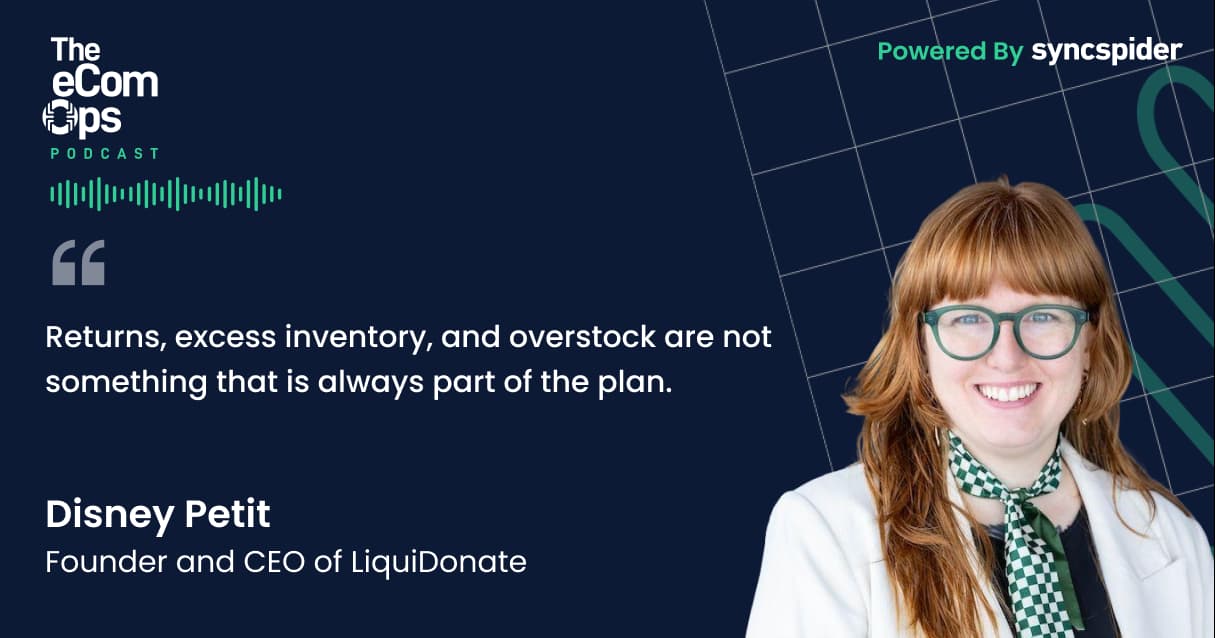
This episode is brought to you by B2Bware
B2Bware by SyncSpider is a self-service B2B portal designed for manufacturers, distributors, and wholesalers that rely on complex pricing, ERP data, and large product catalogs, and don’t want to add more scripts. Schedule Your Free Consultation