
Product content is one of those operational challenges most brands underestimate until it becomes impossible to ignore.
At first, managing a handful of products across one storefront feels manageable. But as brands expand to Amazon, Walmart, Nordstrom, Target, and other channels, every product suddenly needs different images, different specifications, different naming conventions, and different compliance requirements.
What started as a few product photos and descriptions quickly turns into a coordination nightmare.
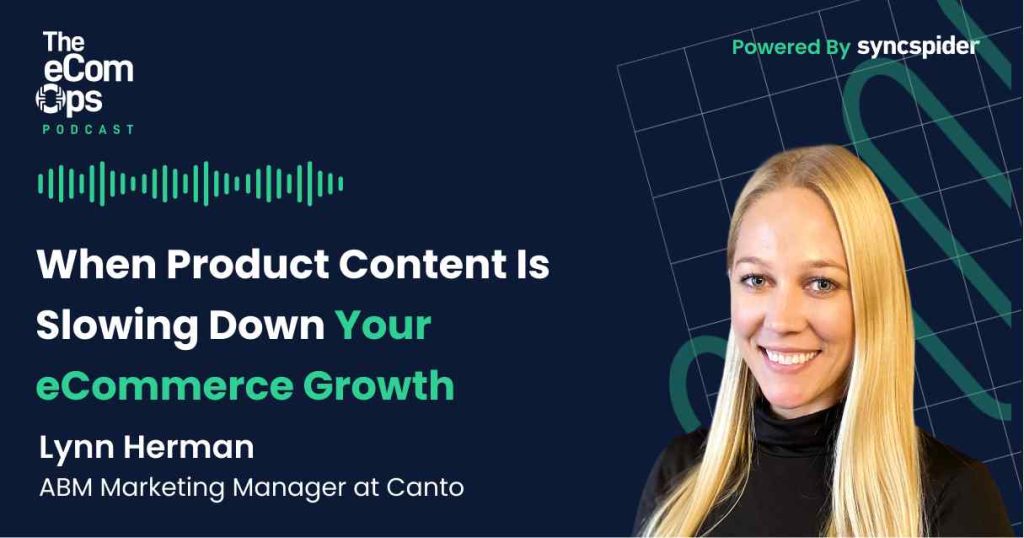
In this episode of the EcomOps Podcast, Lynn Herman, ABM Marketing Manager at Canto, explains why product content becomes one of the biggest hidden challenges in modern eCommerce, and why brands that fail to organize their content infrastructure eventually pay for it through slower launches, listing errors, returns, and operational bottlenecks.
About the Guest
Lynn Herman is an ABM Marketing Manager at Canto with extensive experience in digital asset management, product information management, and content operations. Before joining Canto, she worked at Image Relay, one of the early companies focused on combining product information and digital assets into a single platform. Throughout her career, she has worked closely with brands navigating the challenges of product launches, retailer relationships, content governance, and scaling product information across multiple channels.
Canto is a digital asset management platform that helps brands organize, manage, and distribute digital content from a centralized location. The platform enables marketing, eCommerce, and creative teams to maintain a single source of truth for product assets, automate content workflows, improve searchability through AI-powered tagging, and ensure consistency across marketplaces, retailers, and digital channels.
The Key Takeaways
Product Content Becomes an Operations Problem Faster Than Most Brands Expect
Many brands initially view content as a marketing responsibility. Lynn argues that this mindset creates problems as brands grow.
The moment products are sold across multiple channels, content stops being purely creative and becomes operational.
Every product launch now involves:
- product information
- Specifications
- Images
- campaign assets
- retailer requirements
- marketplace guidelines
- internal approvals
And every additional channel increases complexity.
“You need a single source of truth and you need a single source of truth that puts your product first because that’s the most important thing.”
Why Marketplace Expansion Creates Content Chaos
Selling on your own storefront is relatively straightforward.
Selling on Amazon, Walmart, Nordstrom, Target, and other marketplaces introduces an entirely different level of complexity.
Each platform has its own:
- image requirements
- naming conventions
- product attributes
- content specifications
- upload processes
What used to be a single product listing quickly turns into multiple versions of the same product across different systems.
Without centralized management, teams often find themselves maintaining countless spreadsheets and duplicate workflows.
The Single Source of Truth Matters More Than Ever
One of the strongest messages from the conversation is that content needs a home.
When product information lives in multiple systems, errors become inevitable.
Wrong dimensions. Outdated images. Incorrect materials. Missing attributes.
All of these mistakes can impact customer experience and retailer relationships.
Lynn recommends building a centralized system where product information and digital assets live together and then distributing content from that source into various channels.
The Hidden Cost of Bad Product Information
Many brands don’t realize how expensive content mistakes can be.
Incorrect product information can lead to:
- listing suppression
- product removals
- increased return rates
- customer confusion
- retailer trust issues
And unlike some operational problems, these issues often become visible only after customers have already been impacted.
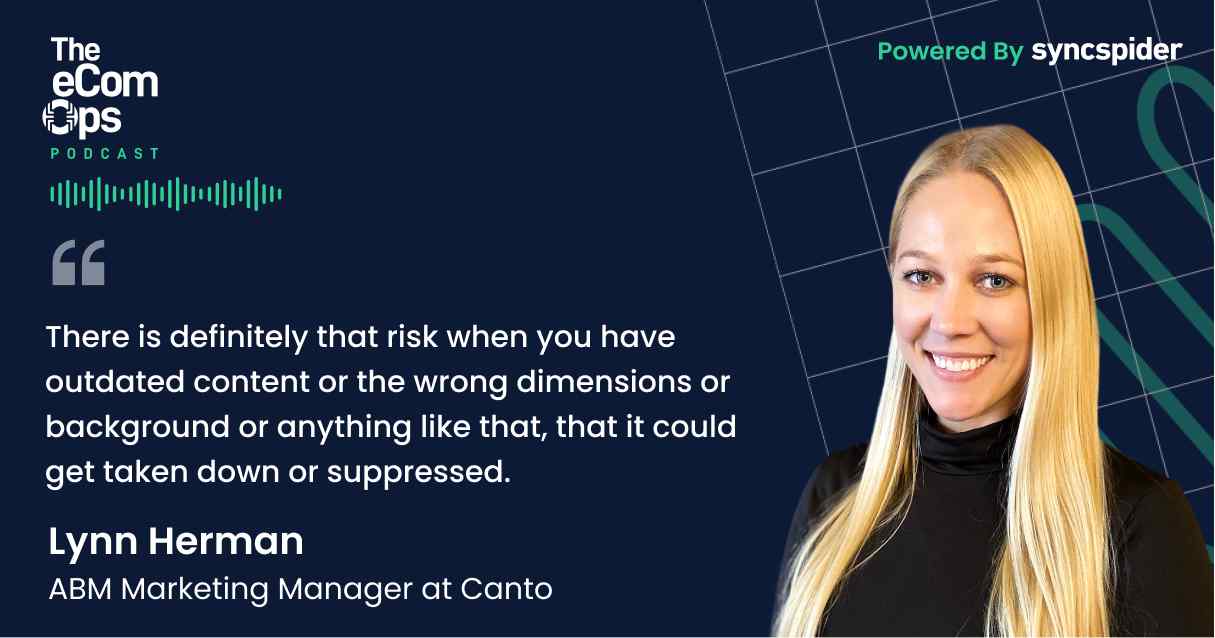
“There is definitely that risk when you have outdated content or the wrong dimensions or background or anything like that, that it could get taken down or suppressed.”
AI’s Biggest Opportunity Isn’t Creativity
The conversation took an interesting turn when discussing AI.
While many companies focus on generating images and content, Lynn sees the biggest opportunity elsewhere.
Organization. Searchability. Efficiency.
AI can automatically:
- tag assets
- generate metadata
- analyze images
- improve search
- organize content libraries
This reduces the time teams spend manually categorizing and locating assets.
“The teams that are going to quote unquote win with AI are gonna use it in an operational fashion instead of trying to create a bunch of new images.”
User Generated Content Is Becoming Essential
Consumers increasingly trust other consumers.
Before making purchases, buyers often search: Instagram, TikTok, reviews, search engines, and community recommendations
Brands no longer fully control their story. Customers are actively shaping it.
That’s why user-generated content continues to play a growing role in eCommerce marketing and product discovery.
The challenge for brands is finding ways to encourage authenticity while still maintaining consistency and access to approved assets.
Why Content Operations Impacts Growth
Product content rarely gets discussed in board meetings.
But it influences nearly every part of the customer experience.
When content operations work well:
- product launches happen faster
- retailers receive accurate information
- returns decrease
- teams collaborate more effectively
- customers gain confidence
When content operations break down, growth becomes harder.
And that’s why Lynn believes brands should stop viewing content as a collection of files and start treating it as operational infrastructure.
Summary
- Product content becomes operational as brands scale
- Marketplace expansion creates significant content complexity
- A single source of truth reduces errors and duplication
- Poor product information increases returns and retailer risk
- AI delivers the most value through organization and searchability
- User-generated content continues to influence purchasing decisions
- Strong content operations create faster and more scalable growth
Resources Mentioned
- Canto – Digital asset management platform that helps brands organize, manage, and distribute digital content at scale.
- Image Relay – Early digital asset and product information management platform acquired by Canto.
- Amazon – Marketplace discussed as an example of channel-specific content requirements.
- Walmart Marketplace – Retail marketplace highlighted for its unique product content specifications.
- Nordstrom – Retail channel mentioned in relation to product information and content management workflows.
- Target – Retail marketplace mentioned as another channel where product content requirements matter.
- Shopify – eCommerce storefront platform discussed in relation to managing and distributing product content.
- TikTok – Social platform mentioned as a place where buyers research products and discover user-generated content.
- Instagram – Social platform mentioned as a place where buyers research products and discover user-generated content.
The No.1 eCom Operations hack
“You need a single source of truth and you need a single source of truth that puts your product first because that’s the most important thing.”
This episode is brought to you by B2Bware
B2Bware by SyncSpider is a self-service B2B portal designed for manufacturers, distributors, and wholesalers that rely on complex pricing, ERP data, and large product catalogs, and don’t want to add more scripts. Schedule Your Free Consultation
See You on the Show!
Enjoyed this episode? Subscribe to the eCom Ops Podcast for more real talk with leaders in eCommerce, tech, and operations. If you’d like to share your story on the show, drop us a message. We’re always on the lookout for smart operators doing meaningful work.
See you next time!