
What happens when a fintech executive applies startup thinking to the beverage industry?
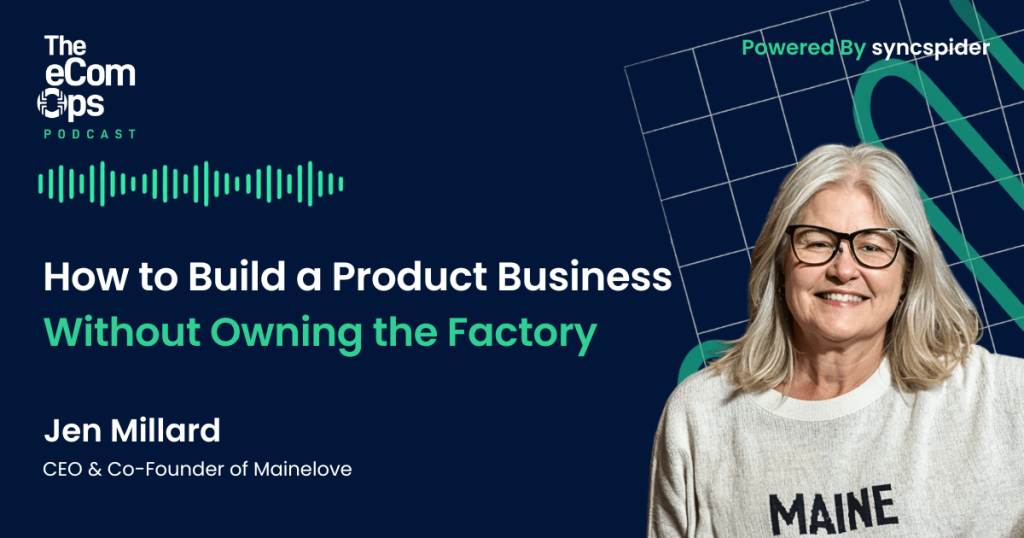
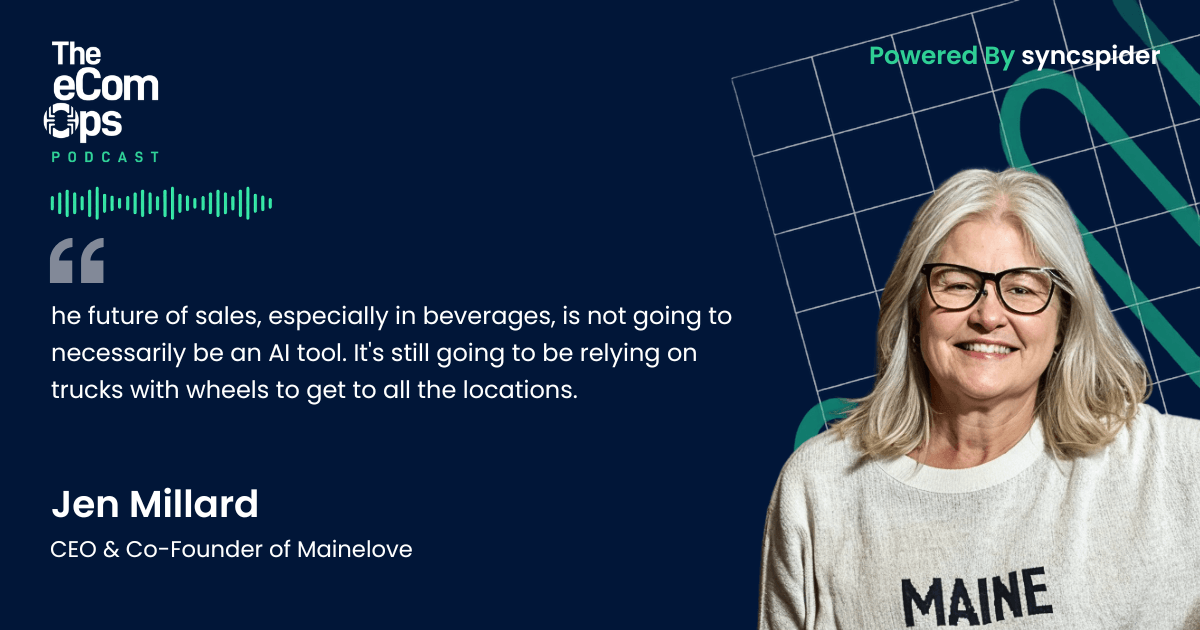
In this episode of the eCom Ops Podcast, Norbert Strappler talks with Jen Millard, CEO & Co-Founder of Mainelove about building an asset-light consumer brand, scaling through distributor partnerships, automating operations without losing the human touch, and challenging the assumptions that hold many companies back.
About
Jen M. Millard has built an unusually diverse career spanning retail, fintech, venture capital, and consumer packaged goods. She began her journey on the retail floor at Sears before rising to Senior Vice President at Saks Fifth Avenue. She later spent nearly two decades helping build technology companies, serving in leadership roles at Mastercard and as an Entrepreneur in Residence at Sutter Hill Ventures.
Over the course of her career, Jen has contributed to multiple successful exits, earned two U.S. patents, and helped launch products ranging from consumer fintech solutions to sustainable household goods. Today, she has returned to her home state of Maine to build Mainelove, a premium canned water company that’s proving you don’t need to own factories to build a national consumer brand.
Mainelove is a premium canned water company built around one simple idea: great water deserves a smarter distribution model.
Rather than investing millions in manufacturing plants, Mainelove partners with local breweries that already have access to Maine’s renowned water sources, creating an asset-light production network capable of scaling nationwide. The company supplies hospitality businesses, colleges, golf courses, stadiums, distributors, and retailers with branded aluminum cans while promoting a more sustainable alternative to single-use plastic.
The company recently expanded to Walmart.com and continues to grow through a nationwide distributor network while maintaining its commitment to local manufacturing and Maine’s water economy.
The Key Takeaways
Why Asset-Light Manufacturing Can Beat Owning Factories
One of the biggest misconceptions in consumer products is that scaling requires massive capital investments in production facilities.
Jen chose the opposite approach.
Instead of buying factories, warehouses, and expensive equipment, Mainelove built relationships with existing breweries that already possessed something invaluable: access to exceptional water and unused production capacity.
Today, multiple breweries operate dedicated water lines exclusively for Mainelove, allowing production to scale without the burden of owning manufacturing assets.
As Jen jokingly puts it: “I own one pallet jack. That’s literally the only thing I own.”
It’s a powerful reminder that competitive advantage often comes from designing smarter systems, not accumulating more assets.
Running a Beverage Company Like a Software Startup
Perhaps the most fascinating insight from the conversation is that Jen never adopted traditional CPG operating models.
Instead, she imported the culture, speed, and execution discipline of fintech.
The company works in two-week sprints. Processes are documented before they’re automated. Slack handles approvals. Custom workflows replace paperwork. Bills of lading are generated through AI-powered workflows.
Instead of accepting “that’s how beverage companies do it,” every operational process is questioned and redesigned.
Her philosophy is simple:
If software startups can iterate quickly, why can’t consumer brands?
That mindset has allowed Mainelove to automate far more of its business than many companies several times its size.
Distribution Is the Real Product
Many founders obsess over manufacturing.
Jen obsesses over distribution.
Rather than selling directly to thousands of individual customers, Mainelove focuses on building relationships with major distributors such as Cisco, US Foods, PFG, Aramark, and Southern Glazer’s.
Those partnerships unlock national reach without requiring a massive internal sales force.
But winning distributors isn’t simply about offering another product.
It requires constant relationship management, market support, activations, and helping distributors sell, not expecting them to do all the work themselves.
For Jen, distribution isn’t the final step.
It’s the business itself.
Automation Should Remove Repetition—Not Relationships
Despite her deep technology background, Jen offers a refreshingly balanced perspective on automation.
Yes, repetitive workflows should absolutely be automated. But not everything should.
Sales still depend on conversations. Retail still depends on people. Distributor relationships still require trust.
One example she shares is sending interns into stores, not to collect data, but to build confidence by speaking directly with owners and buyers.
Technology handles repeatable processes. People create opportunities.
It’s a distinction many businesses forget while chasing the latest AI trend.
Sometimes Not Knowing the Rules Is Your Biggest Competitive Advantage
Most beverage veterans told Jen the timeline she envisioned was impossible. Too many licenses, distributors, complexity.
She ignored all of it.
Not because she was reckless, but because she wasn’t conditioned by industry assumptions.
Within just 18 months, Mainelove secured more than 20 licenses and rapidly expanded its distribution footprint.
Her previous experience taught her to test assumptions instead of accepting them.
Sometimes experience creates expertise. Other times, it creates invisible limitations.
Fresh perspectives can move much faster simply because they never learned where the imaginary walls were.
Great Companies Are Built by Great People
The episode closes with one of the most thoughtful discussions we’ve heard on the podcast.
When asked who shaped her career, Jen points to three mentors from retail, engineering, and executive leadership.
Each taught different lessons.
- Fight for your people.
- Build teams that genuinely enjoy working together.
- Lead with both clarity and empathy.
She argues that founders don’t need to know everything before they begin.
They need curiosity, courage, and the willingness to learn from others along the way.
It’s a lesson that applies far beyond consumer products.
Resources Mentioned
- Walmart – Global retail company (Mainelove’s newest retail partner).
- Southern Glazer’s Wine & Spirits – Largest U.S. alcohol distributor working with Mainelove.
- Slack – Used for internal approvals and operational workflows.
- Asana – Used to manage projects and workflows before further automation.
- Lovable – No-code AI platform used to build Mainelove’s automated bill-of-lading workflow.
- Liquid Death – Canned water brand
- Red Bull – Energy drink company
- Bessemer Venture Partners – Venture capital firm (investor in Jen’s fintech startup).
The No.1 eCom Operations hack
“You have a thesis, you have signals, but you know, you’re probably 80% right. You’re not going to be a hundred.”
This episode is brought to you by B2Bware
B2Bware by SyncSpider is a self-service B2B portal designed for manufacturers, distributors, and wholesalers that rely on complex pricing, ERP data, and large product catalogs, and don’t want to add more scripts. Schedule Your Free Consultation
See You on the Show!
Enjoyed this episode? Subscribe to the eCom Ops Podcast for more real talk with leaders in eCommerce, tech, and operations. If you’d like to share your story on the show, drop us a message. We’re always on the lookout for smart operators doing meaningful work.
See you next time!