
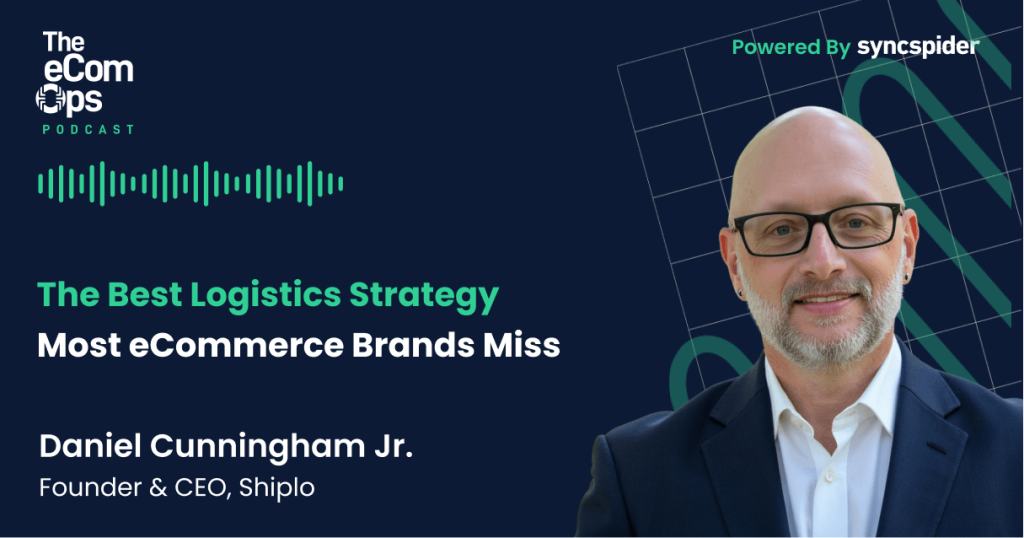
Are you spending time improving acquisition, conversion, and customer experience? That’s great, but did you know that, meanwhile, one of the biggest profit leaks often sits quietly in the background: Logistics.
Not because shipping is expensive. Because logistics decisions are fragmented across carriers, warehouses, spreadsheets, fulfillment centers, marketplaces, and disconnected systems.
In this episode of the EcomOps Podcast, Daniel Cunningham Jr., Founder and CEO of Shiplo, explains why logistics should no longer be treated as a cost center and how modern brands can use data, automation, and AI-driven workflows to turn fulfillment into a competitive advantage.
About the Guest
Daniel Cunningham Jr. is a serial entrepreneur and logistics technology leader who has spent more than two decades building, scaling, and exiting companies focused on fulfillment, shipping, transportation, and operational efficiency. Throughout his career, he has helped brands solve increasingly complex logistics challenges as they grow across channels, warehouses, and markets.
Today, he is the Founder and CEO of Shiplo, where he focuses on creating a more connected, transparent, and intelligent logistics ecosystem powered by automation, AI agents, and data-driven decision-making.
Shiplo is an AI-powered logistics orchestration platform designed to help brands coordinate fulfillment across carriers, warehouses, marketplaces, and distribution channels. Rather than functioning as a simple shipping platform, Shiplo acts as a central control layer that helps businesses optimize routing, carrier selection, operational workflows, and shipment visibility.
The platform combines logistics infrastructure with agent-based automation, allowing businesses to create custom AI workflows for returns, claims, routing, customer communication, inventory management, and operational decision-making.
The Key Takeaways
Why Logistics Problems Stay Invisible Until They Become Expensive
Most brands don’t notice logistics problems immediately.
The damage usually hides inside averages.
Shipping costs look acceptable on monthly reports while margin quietly disappears at the shipment level through inefficient routing, incorrect packaging, poor carrier selection, inventory placement issues, or unnecessary service levels.
By the time operators see the problem in their P&L, the losses have already accumulated.
The First Thing That Breaks When Brands Scale
According to Daniel, the first casualty of growth is visibility.
Adding Shopify, Amazon, wholesale accounts, retail partners, marketplaces, and multiple fulfillment centers creates operational complexity faster than most systems can handle.
Suddenly teams need answers to questions like:
- Where did the order originate?
- Which warehouse should fulfill it?
- Which carrier is best for this shipment?
- What delivery promise was made?
- What is the actual landed cost?
Without a centralized control layer, businesses fall back on spreadsheets, emails, and tribal knowledge.
That’s where costly mistakes begin.
Why the Cheapest Shipping Rate Is Often the Most Expensive Choice
One of the biggest misconceptions in logistics is that negotiating the lowest carrier rate automatically creates savings. It doesn’t.
The real optimization happens when brands choose the right carrier, from the right warehouse, using the right packaging, for the right destination and service level.
A discounted rate applied to the wrong shipment is still wasted money.
The best logistics strategy focuses on outcomes, not price sheets.
Why Multi-Carrier Strategies Often Outperform Single-Carrier Agreements
Many brands commit to a single carrier because of attractive volume discounts.
The problem?
Not every carrier performs equally well in every region, lane, or delivery scenario.
Daniel argues that the real advantage comes from optionality.
Regional carriers, local delivery providers, national networks, and zone-skipping strategies all have different strengths.
When businesses have access to multiple options, they can optimize every shipment individually instead of forcing every package through the same network.
AI Agents Are Becoming Logistics Operators
One of the most interesting parts of the discussion was Daniel’s vision for agent-driven logistics.
Instead of relying on fixed workflows, businesses can create specialized AI agents that manage:
- routing exceptions
- returns
- claims
- inventory alerts
- invoice reviews
- customer communication
- pickup coordination
The goal isn’t to replace operators.
The goal is to give every operator their own scalable digital workforce.
Why Logistics Is Actually a Growth Lever
Most companies view shipping as something that happens after a sale.
Daniel disagrees.
Delivery speed, fulfillment accuracy, carrier performance, customer communication, and packaging all influence customer trust and repeat purchases.
In other words:
Logistics is part of the product experience.
Brands that optimize logistics don’t just reduce costs.
They improve customer retention, increase operational flexibility, and create better buying experiences.
Data Quality Will Decide Which Companies Win the AI Era
As AI tools become available to everyone, technology itself stops being the differentiator.
Daniel believes the winners will be the companies with:
- clean data
- operational discipline
- strong processes
- clear customer promises
- trusted relationships
AI can only amplify what already exists.
If the underlying systems are fragmented, AI simply accelerates the chaos.
Summary
- Logistics is often the biggest hidden profit leak in eCommerce.
- Visibility comes before optimization.
- The lowest shipping rate isn’t always the best strategy.
- Growth increases complexity faster than most systems can handle.
- AI will become a logistics co-pilot.
- Logistics directly impacts customer experience.
- The companies that win will have the cleanest data.
Resources Mentioned
- Shiplo – AI-powered logistics orchestration platform that helps brands coordinate carriers, warehouses, routing, and fulfillment operations.
- Shopify – eCommerce platform referenced as a common order source for growing brands.
- Amazon – Marketplace channel discussed in relation to multi-channel fulfillment complexity.
- AI Agents – Specialized workflow agents used to automate logistics tasks such as returns, claims, routing, and customer communication.
- 3PL (Third-Party Logistics Providers) – External fulfillment partners used by brands to store inventory and ship orders.
- 4PL (Fourth-Party Logistics Providers) – Logistics coordinators that manage multiple fulfillment and transportation partners across a broader supply chain network.
The No.1 eCom Operations hack
“You have to see what is happening at the order level, lane level, the carrier level, the zone level, package service level and service level before you can actually optimize.” 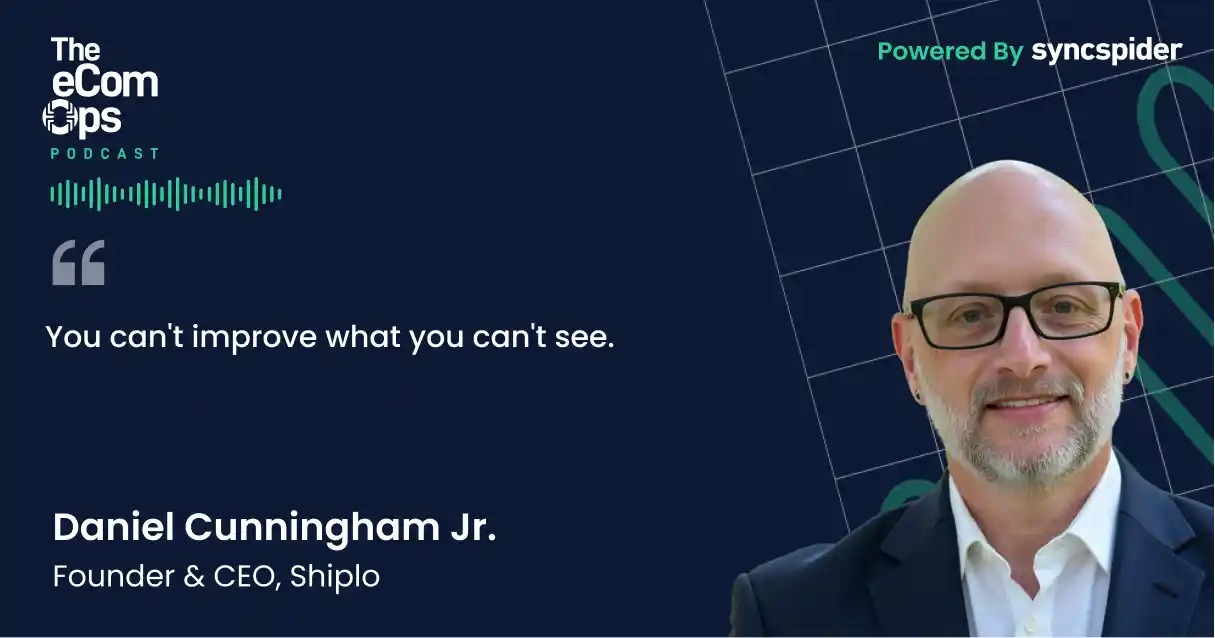
This episode is brought to you by B2Bware
B2Bware by SyncSpider is a self-service B2B portal designed for manufacturers, distributors, and wholesalers that rely on complex pricing, ERP data, and large product catalogs, and don’t want to add more scripts. Schedule Your Free Consultation
See You on the Show!
Enjoyed this episode? Subscribe to the eCom Ops Podcast for more real talk with leaders in eCommerce, tech, and operations. If you’d like to share your story on the show, drop us a message. We’re always on the lookout for smart operators doing meaningful work.
See you next time!