
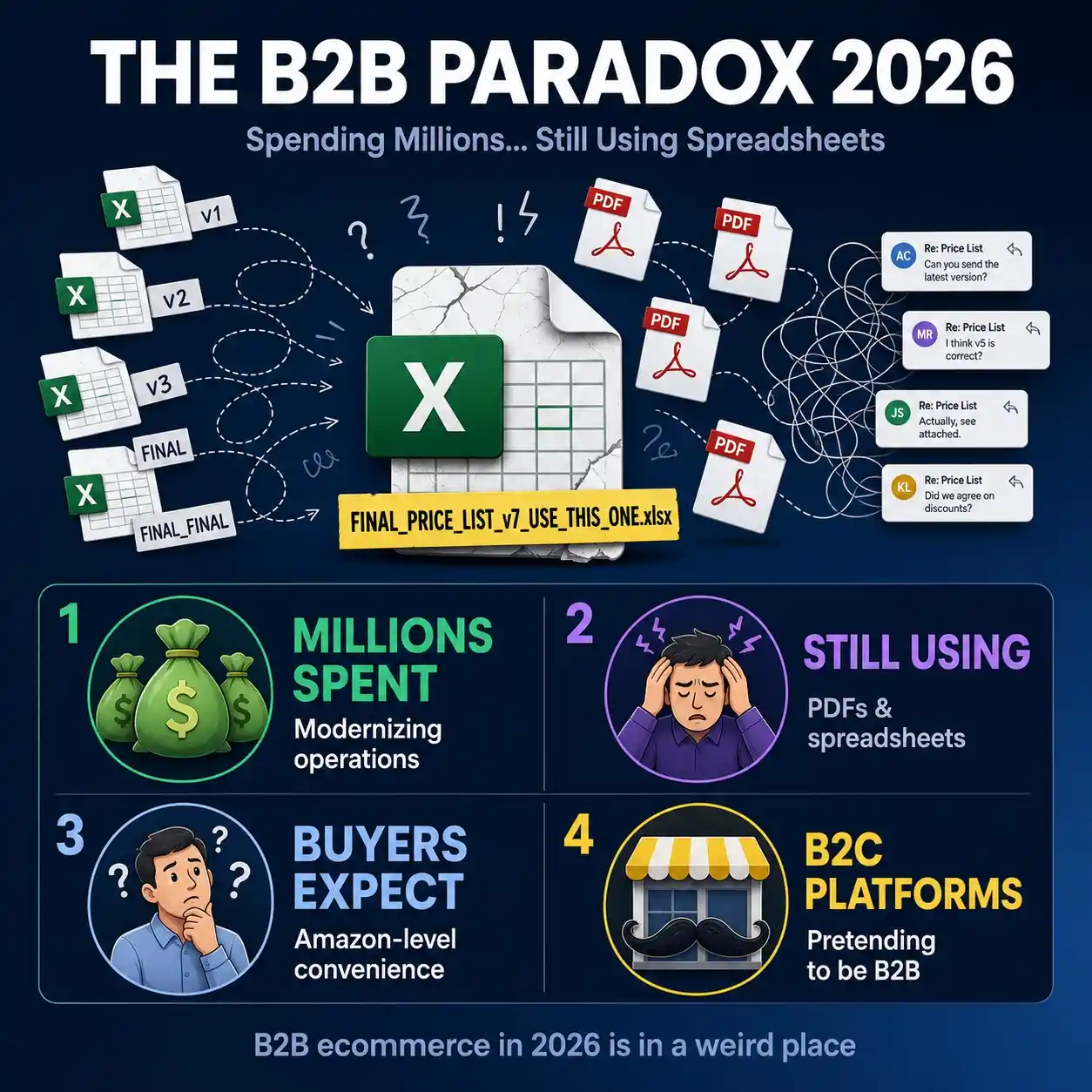
Over the last year, I’ve had the strange pleasure of watching manufacturers spend millions modernizing operations… only to keep processing wholesale orders through PDFs, spreadsheets, and email threads named something like:
FINAL_PRICE_LIST_v7_USE_THIS_ONE.xlsx
B2B ecommerce in 2026 is in a weird place. Buyers expect Amazon-level convenience, procurement teams want self-service portals, sales reps want fewer manual orders, and operations teams just want the ERP to stop catching fire every Friday afternoon.
Meanwhile, half the “B2B platforms” on the market are still basically B2C storefronts wearing a fake mustache and pretending they understand contract pricing.
So I decided to dig properly.
I went through Reddit discussions, recent G2 reviews, implementation feedback, pricing structures, ERP integration capabilities, and platform positioning to figure out which B2B platforms are actually built for manufacturers, wholesalers, and distributors… and which ones become operational nightmares the moment complexity enters the room.
Because once you introduce:
- customer-specific pricing
- distributor hierarchies
- multi-warehouse inventory
- ERP synchronization
- approvals
- quoting workflows
- regional catalogs
- sales reps
- procurement teams
…the conversation changes completely.
This is no longer “Which ecommerce platform looks nice?”
It becomes:
“Which platform won’t destroy our operations six months after launch?”
And honestly, that’s the only question that matters.
TL;DR
- Best overall for manufacturers & distributors: B2Bware
Strong ERP connectivity, operational flexibility, and faster implementation without enterprise-level complexity. - Best for companies already on Shopify: Shopify B2B
Excellent UX and onboarding, but advanced B2B workflows often require apps and workarounds. - Best for enterprise procurement complexity: OroCommerce
Deep B2B-native functionality with approvals, RFQs, and account hierarchies, but requires technical resources. - Best for SAP & Microsoft Dynamics users: Sana Commerce
ERP-first approach with real-time synchronization, ideal for manufacturers already heavily invested in ERP systems. - Best for unlimited customization: Adobe Commerce
Extremely powerful and scalable, but expensive and development-heavy. - Best mid-market balance: BigCommerce B2B
Good SaaS flexibility and easier implementation, though still more B2C-oriented underneath. - Best for composable/API-first architecture: commercetools & Virto Commerce
Excellent for enterprises building modular commerce ecosystems, but require strong internal dev teams. - Best for Salesforce-centric organizations: Salesforce B2B Commerce
Strong CRM-commerce alignment, but complexity and ecosystem dependency can become expensive long-term. - Best for global enterprise operations: SAP Commerce Cloud
Enterprise-grade scalability and ERP integration, but often overwhelming for mid-market companies. - Biggest 2026 trend:
The winning B2B platforms are no longer just storefronts. They’re becoming operational systems focused on ERP synchronization, workflow automation, procurement, inventory visibility, and AI-ready infrastructure.
What Is the Best B2B Platform for Manufacturers in 2026?
The best B2B platform for manufacturers in 2026 depends largely on operational complexity. Companies with ERP-driven workflows, contract pricing, distributor networks, and multi-warehouse operations usually need platforms purpose-built for B2B commerce, such as B2Bware, OroCommerce, Sana Commerce, or Adobe Commerce. Simpler wholesale businesses often lean toward Shopify B2B for ease of use and faster deployment.
How I Evaluated These Platforms
I didn’t want this to become another recycled “Top 10 Platforms” article where every tool magically gets a perfect score, and the conclusion is basically:
“Choose the one that fits your business needs.”
Groundbreaking stuff.
So instead, I evaluated these platforms based on things that actually matter in real B2B operations:
- ERP integration depth
- customer-specific pricing
- distributor and dealer workflows
- self-service functionality
- quoting and approval flows
- scalability for large catalogs
- implementation complexity
- flexibility for manufacturers
- Reddit discussions from 2025–2026
- G2 reviews and recurring complaints
- AI readiness and automation potential
- real operational fit for manufacturers and distributors
I also paid close attention to something many listicles ignore entirely: How these platforms behave once complexity shows up. (Because almost every platform looks good during the demo.)
The real test begins when:
- your ERP contains 200,000 SKUs
- five customer groups need different catalogs
- inventory sync breaks
- one distributor sees the wrong price
- sales reps start bypassing the portal
- procurement teams demand approvals
- finance wants account-based purchasing
- your “simple B2B setup” suddenly becomes international
That’s where platforms reveal who they really are.
Quick Comparison Table
If you need just a quick glance at the top B2B portal solutions, here’s a comparison table:
B2B Platform Comparison
An overview of leading B2B e-commerce platforms across key metrics
| Platform | G2 Score | Best For | ERP Integration | B2B Complexity | Implementation | Tech Required | Pricing |
|---|---|---|---|---|---|---|---|
|
B2Bware★ Top Pick
|
4.8 / 5 | Manufacturers & distributors with ERP-heavy workflows | Excellent | Excellent | Fast | Low – Medium |
Starts at €499/mo
|
|
Shopify B2B
|
4.4 / 5 | Brands adding wholesale to existing DTC operations | Moderate | Moderate | Very Fast | Low |
Shopify Plus~$2,300/month+
|
|
OroCommerce
|
4.3 / 5 | Enterprise procurement and distributor complexity | Excellent | Excellent | Slow | High |
Custom Pricing
|
|
Sana Commerce
|
4.4 / 5 | SAP & Microsoft Dynamics manufacturers | Excellent | High | Medium | Medium |
Custom Pricing
|
|
Adobe Commerce
|
4.5 / 5 | Large enterprises needing extreme customization | Excellent | Excellent | Slow | High |
Custom Pricing
|
|
BigCommerce B2B
|
4.2 / 5 | Mid-market hybrid B2B/B2C businesses | Good | Medium | Fast | Low – Medium |
Custom Pricing
|
|
Virto Commerce
|
4.6 / 5 | API-driven composable enterprise ecosystems | Excellent | High | Slow | Very High |
0.5% GMVor ~$2/order
|
|
Salesforce B2B
|
4.4 / 5 | Companies already deep inside Salesforce ecosystem | Good | High | Slow | High |
Custom Pricing
|
|
SAP Commerce Cloud
|
4.3 / 5 | Global enterprises with massive operational complexity | Excellent | Excellent | Very Slow | Very High |
Custom Pricing
|
1. B2Bware: Best for ERP-First B2B Companies
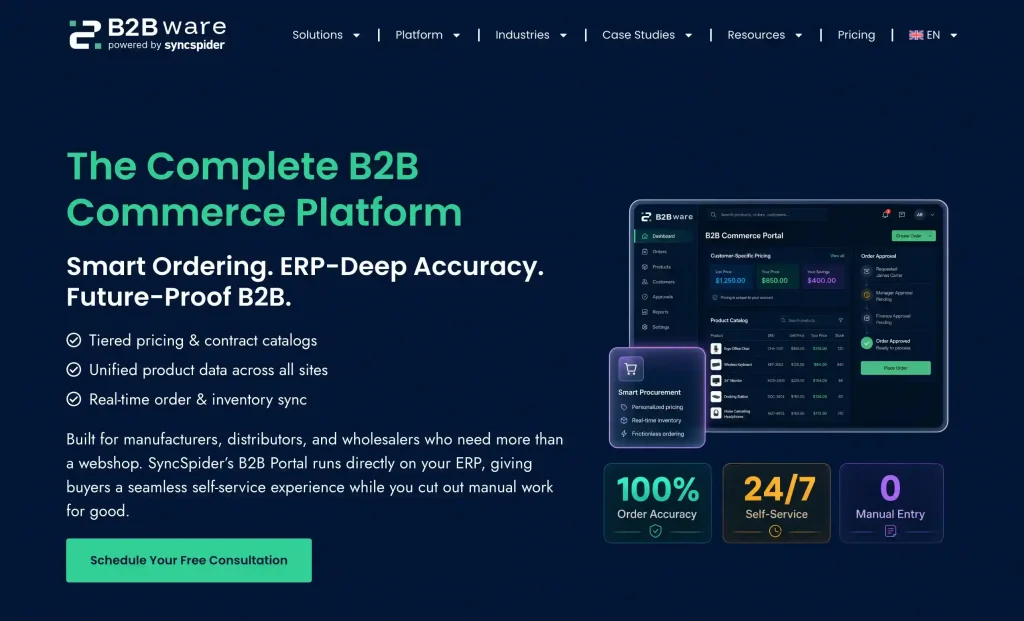
B2Bware is a new product from SyncSpider, a software solution known in e-commerce circles for its integration and automation capabilities. With B2Bware, a B2B portal, it leveraged the infrastructure and 15 years of experience to enable manufacturers to sell their products to distributors and wholesalers, without needing to change every single tool, ERP, and PIM they already use.
Best for:
Manufacturers, distributors, and ERP-heavy B2B companies that need operational flexibility without the pain of enterprise-level implementation.
What stood out:
What stood out to me immediately is that B2Bware actually behaves like it was designed by people who understand B2B operations instead of people who mostly sell hoodies online and later added a “wholesale mode.”
That sounds harsh.
But after reviewing platform after platform, you start noticing how many “B2B solutions” are really just retail systems trying to survive complex procurement logic.
B2Bware leans heavily into:
- ERP synchronization
- customer-specific pricing
- distributor structures
- quoting
- buyer self-service
- white-label portals
- operational flexibility
And honestly, that’s the right direction for 2026.
The strongest positioning here is that it doesn’t try to pretend B2B complexity doesn’t exist. It embraces it.
What Reddit users say
It’s a new B2B eCommerce software solution, so there are not too many comments and mentions on Reddit, but I did find some recommendations, especially regarding tiered pricing and account-based access. It’s mentioned in discussions regarding ERP synchronization, pricing inconsistencies, distributor permissions, catalogs, and approval workflows.

And this is exactly the area where B2Bware positions itself most aggressively.
What G2 users said:
SyncSpider has a 4.8/5 score on G2, but its B2B portal still lacks reviews.
What I found interesting
The AI angle is surprisingly forward-looking. Their MCP connector approach basically treats the portal as a system that AI agents can navigate and interact with. That sounds futuristic until you realize procurement automation is already underway.
Most B2B platforms still think “AI” means generating product descriptions… Meanwhile, the real shift is operational AI.
Pros
- Strong ERP-first architecture
- Built for complex B2B workflows
- White-label flexibility
- Contract pricing support
- Distributor-friendly structure
- Faster implementation positioning
Cons
- Less mainstream brand recognition
- Smaller ecosystem than Shopify or Adobe
- May be overkill for very small wholesale businesses
Price:
The starting price for the B2Bware solution is €499/month with a two-year term.
My verdict
This feels like one of the few platforms genuinely optimized for operational B2B complexity instead of simplified wholesale.
And in 2026, that distinction matters more than ever
2. Shopify B2B: Best for Brands Expanding from DTC into Wholesale
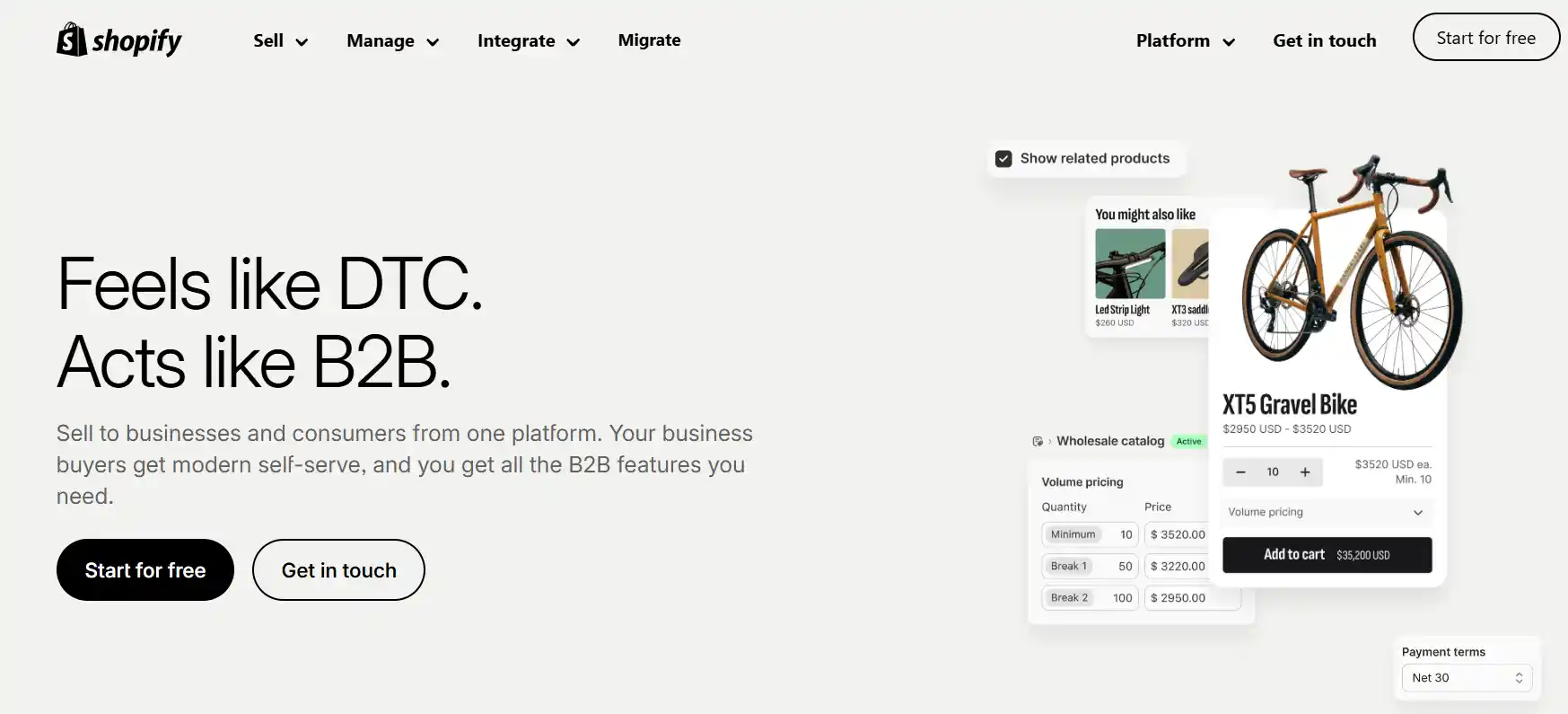
Shopify started as a retail ecommerce giant, but over the last few years, it has aggressively expanded into B2B commerce with native wholesale features, customer-specific catalogs, company accounts, and self-service ordering. The platform’s biggest strength is its simplicity: companies can manage both DTC and B2B operations from a single ecosystem without building separate commerce infrastructures.
Best for:
Brands already on Shopify that want to quickly add wholesale capabilities but don’t have a too-complex workflow.
What stood out:
Shopify is the most interesting platform on this list because it’s simultaneously extremely powerful, polished, and occasionally frustrating for complex B2B. And all things are true at the same time.
If your business runs relatively straightforward wholesale operations, Shopify B2B can work beautifully.
If your business looks like:
- multiple warehouses
- complex approvals
- distributor hierarchies
- ERP dependency
- region-specific catalogs
- negotiated pricing structures
…you may eventually discover where the platform’s B2C DNA starts showing through the walls.
What Reddit users say
Reddit users consistently praise Shopify for being easy to use, for its onboarding speed, clean UX, and app ecosystem. But a few days back, there was a discussion about Shopify B2B ICP, which targeted those with $12M to $200M in revenue and without complex workflows. So, that means if you have a bit more demanding workflow or make less than $12M, they didn’t build the platform for you.
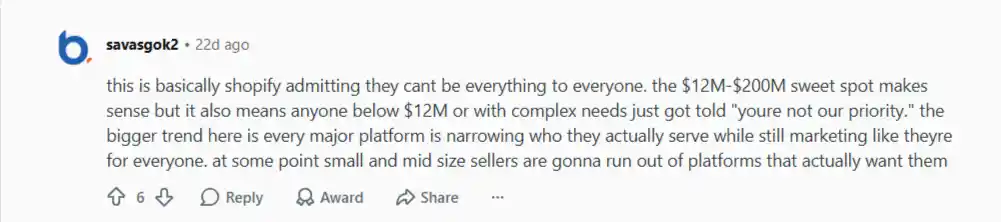
That pattern appears constantly in discussions around wholesale operations.
What G2 users say
Shopify Plus has a 4.4/5 rating on G2, and reviewers repeatedly highlight Shopify’s usability and operational simplicity. The problem is that complex B2B operations naturally create friction, especially for B2B, inventory logic, subscriptions, or custom pricing.
Pros
- Excellent UX
- Huge ecosystem
- Fast deployment
- Strong unified B2C/B2B capabilities
- Easy onboarding
Cons
- B2B features require Shopify Plus
- Heavy reliance on apps for advanced workflows
- Less flexible for ERP-heavy operations
- Complex pricing logic can get messy
My verdict
Shopify B2B works best when wholesale is an extension of a strong retail operation. Once B2B becomes operationally dominant, many companies start looking elsewhere.
3. OroCommerce: Best for Enterprise-Level B2B Complexity with a Tech Team
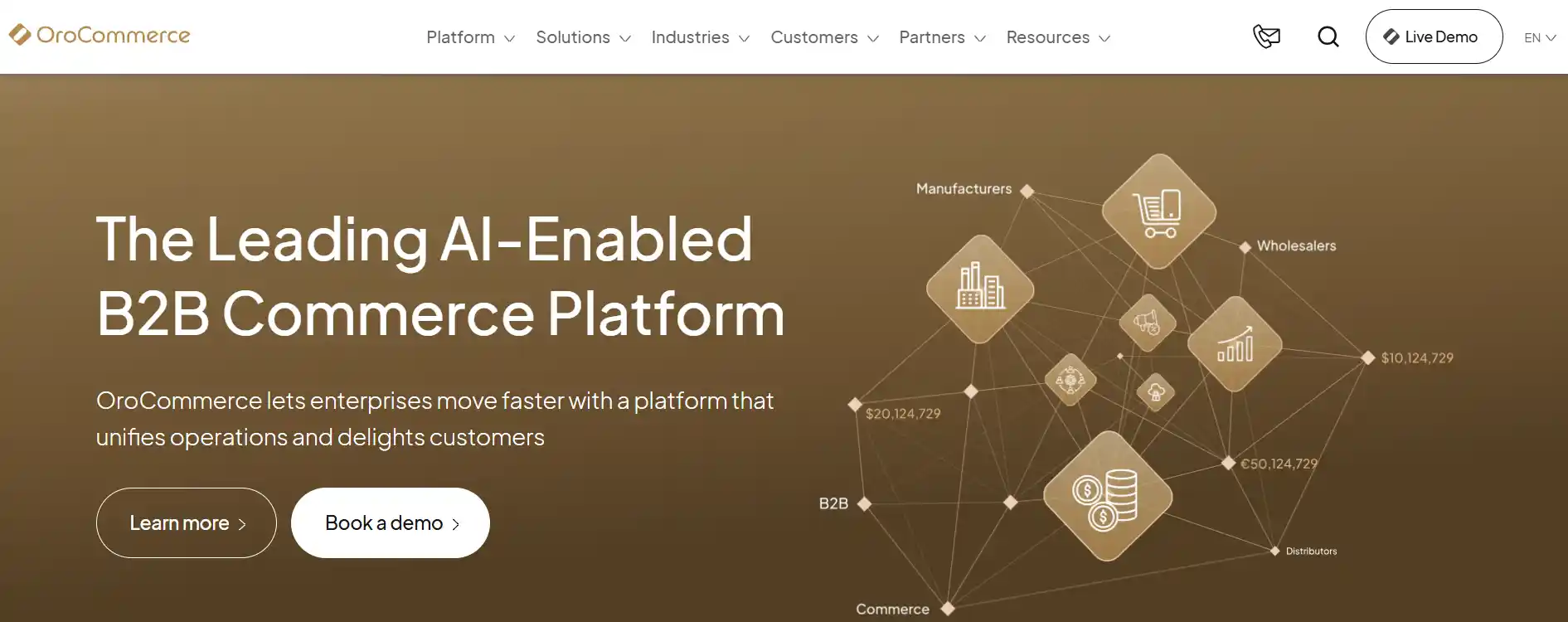
OroCommerce was built specifically for B2B commerce from the ground up, and honestly, you can feel that almost immediately. Unlike many platforms that evolved from retail ecommerce, OroCommerce focuses heavily on enterprise procurement workflows, account hierarchies, RFQs, quoting systems, approvals, and complex organizational structures that manufacturers and distributors typically struggle to manage inside retail-first platforms.
Best for:
Enterprise manufacturers and distributors with serious B2B complexity and with development resources.
What stood out:
OroCommerce feels like the platform equivalent of someone handing you a military-grade toolkit. Impressive? Absolutely. Slightly intimidating? Also yes.
This platform was clearly built specifically for B2B operations from day one, and you can feel it immediately.
The depth is enormous. and goes all the way through account hierarchies, workflows, permissions, RFQs, quoting, CRM integration, and multi-org support. This is not “wholesale lite”.
What Reddit users say
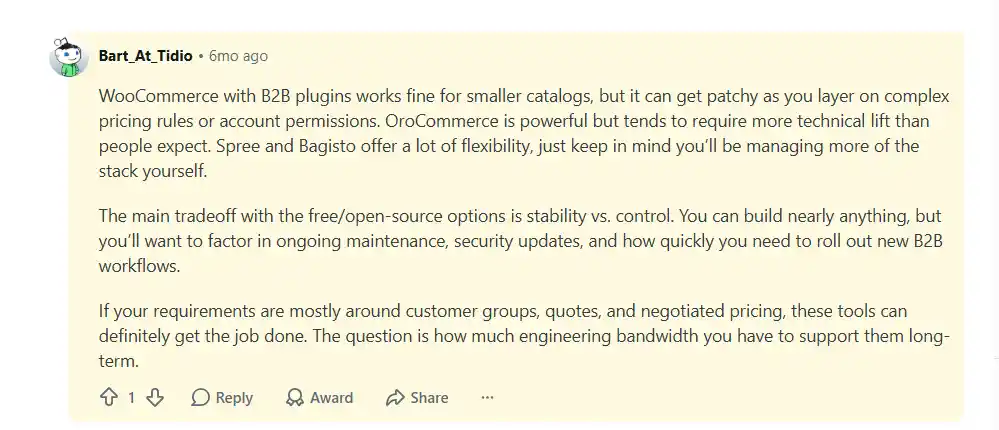
OroCommerce gets mentioned frequently in Reddit discussions involving ERP-heavy operations, complex pricing, enterprise procurement, and manufacturer workflows, especially when conversations move beyond “simple wholesale,” but you will need more technical knowledge to conquer it.
What G2 users say
The G2 score for OroCommerce is 4.3/5, and users acknowledge its capabilities when it comes to the complexity of B2B, but almost all of them note its pretty challenging for non-tech users to get close with even basic tasks such as updating product listings, adjusting pricing rules, or modifying workflows, which creates additional frustration.
What I noticed
The platform consistently appears in conversations around “real B2B complexity.” That’s important. Because platforms that repeatedly appear in enterprise workflow discussions usually earned that reputation through painful implementation realities. But if you’re coming from a “lighter” platform, like Shopify, bring a tech person with you, or you’ll need a decade to set everything right. And, to be honest, even with a tech team, the deployment time might be longer than with other platforms, so make sure to calculate it in your time-line.
Pros
- Deep B2B functionality
- Excellent enterprise workflows
- Strong permissions and organization logic
- Powerful quoting and approvals
- Purpose-built for B2B
Cons
- Steeper learning curve
- Enterprise complexity
- Longer implementation cycles
- Potentially overwhelming for smaller teams
Price:
OroCommerce offers a free (open-source) option – Community Edition, but for advanced features, you’ll need to contact them for pricing information, as pricing is not publicly available.
My verdict
OroCommerce is what happens when a platform fully commits to B2B instead of trying to balance retail simplicity with wholesale complexity. For the right company, that’s a massive advantage, and for smaller companies (especially those without a development team), I would recommend a platform that is easier to handle.
CTA: Need a B2B portal that could be implemented in a month?
B2Bware is your go-to solution. It handles complex workflows and pricing, but is still easy to implement.
4. Sana Commerce: Best for B2B with SAP or Microsoft Dynamics ERP systems
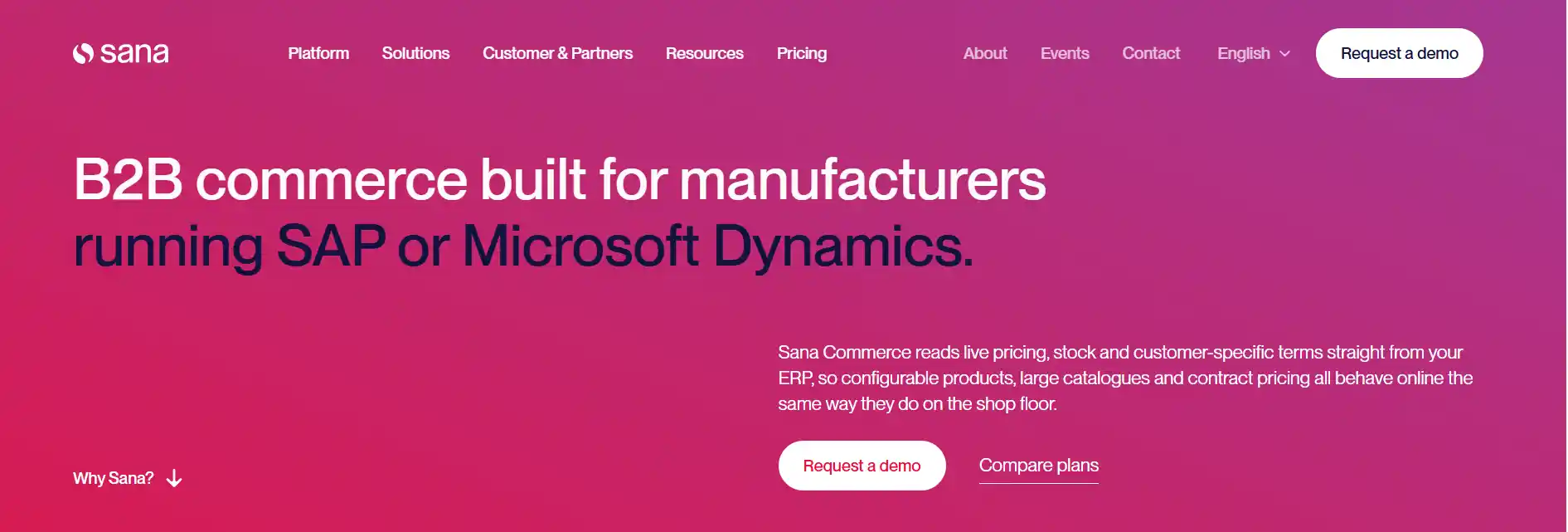
Sana Commerce built its reputation around a very specific idea: your ERP should remain the operational brain of your business. Instead of creating disconnected e-commerce environments, Sana Commerce connects directly to ERP systems such as SAP and Microsoft Dynamics to provide real-time inventory, pricing, customer data, and order synchronization for manufacturers and wholesalers operating at scale.
Best for:
Manufacturers already deeply invested in ERP systems like SAP or Microsoft Dynamics.
What stood out:
Sana Commerce has one huge strategic advantage: it leans heavily into ERP-native thinking. And honestly, that’s smart.
Instead of treating ERP integration as an afterthought, Sana positions the ERP as the operational source of truth. That matters enormously in manufacturing. Because once pricing, inventory, customer data, and fulfillment drift away from the ERP, chaos usually follows shortly afterward.
What Reddit users say
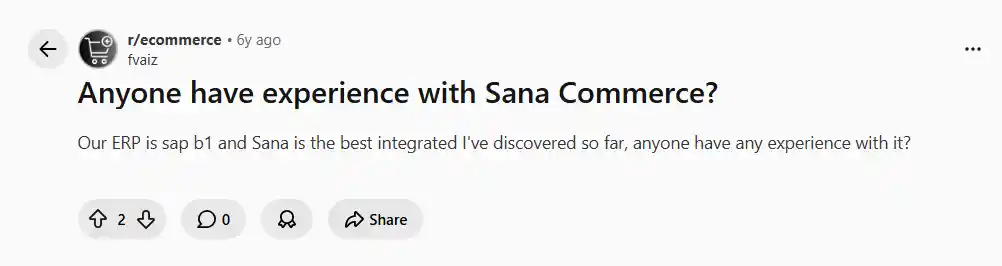
Redditors are not too chatty about Sana; they do mention it’s great for integration with SAP, but other than that, you won’t find any relevant comments on this forum.
What G2 users say
Sana Commerce has a 4.4/5 rating on G2, and users are satisfied with its integration capabilities and ease of use. On the flip side, missing features and pricing are mentioned often. But you have to take all of this with a grain of salt, since the latest review on G2 was from 2023.
Pros
- Strong ERP integration
- Excellent for manufacturers
- Real-time operational synchronization
- Strong self-service capabilities
Cons
- ERP dependency can limit flexibility
- Longer setup cycles
- More enterprise-oriented
Price:
Sana Commerce pricing is not public. They have three plans, but you have to book a demo to find out the pricing.
My verdict
Sana makes the most sense when your ERP already runs the business, but that ERP system needs to be SAP B1, ECC, or Cloud ERP, or Microsoft Dynamics 365 BC, NAV, AX, or F&SCM. If you use another ERP, you’ll need to look for a different B2B commerce platform, as you will not be able to integrate it with Sana.
5. Adobe Commerce B2B: Best for Large Enterprises That Need Unlimited Customization
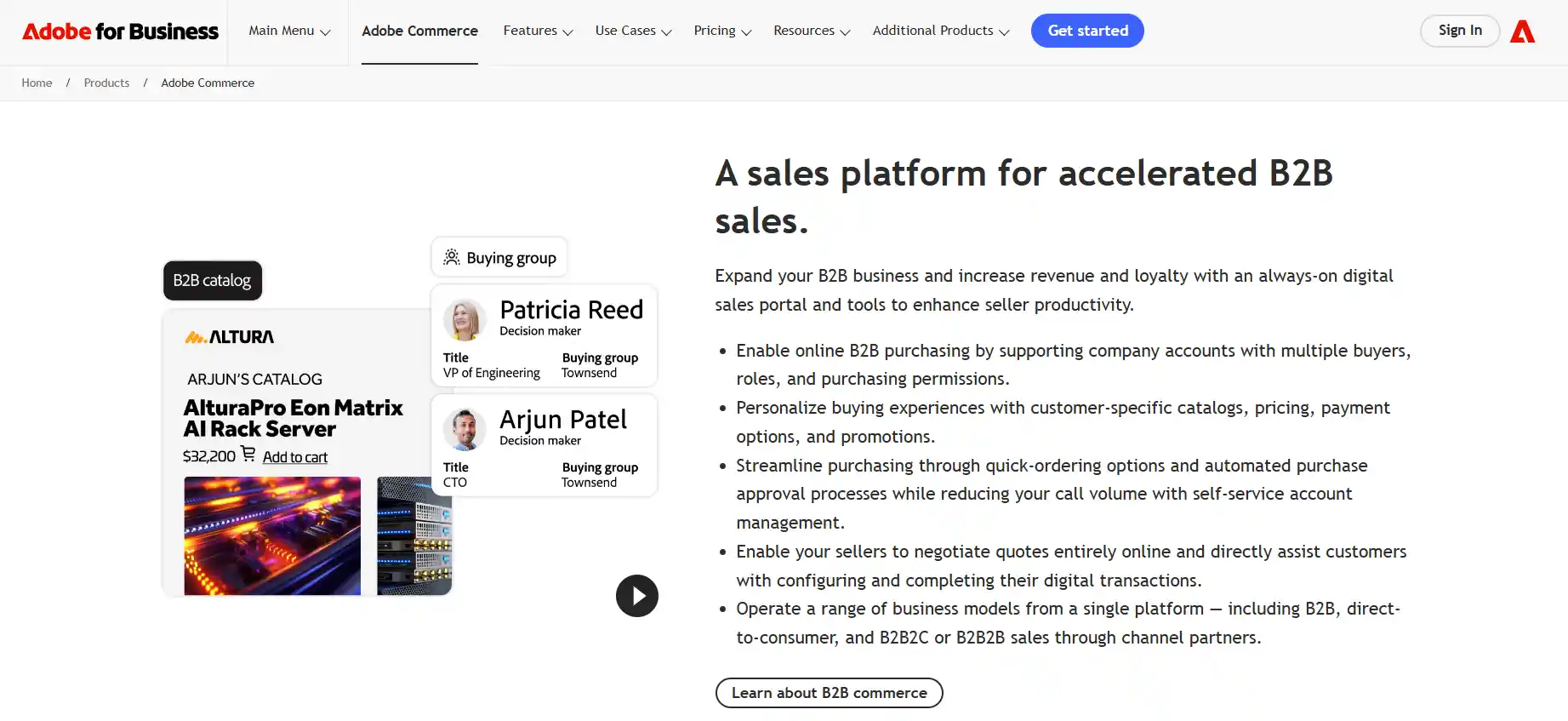
Adobe Commerce, formerly Magento Commerce, remains one of the most customizable B2B commerce platforms on the market. It is heavily used by global enterprises that need advanced workflows, large product catalogs, custom integrations, and highly tailored buying experiences. The trade-off, of course, is complexity: Adobe Commerce can do almost anything, but it usually requires substantial development resources to achieve it.
Best for:
Large enterprises needing extreme customization.
What stood out:
Adobe Commerce is basically the answer to: “What if we wanted unlimited flexibility and occasional emotional damage?” The customization possibilities are enormous. So are the implementation realities.
Adobe remains incredibly powerful for massive catalogs, advanced workflows, custom integration, enterprise logic, and global operations. But this power comes with complexity, cost, and development dependency.
What Reddit users say
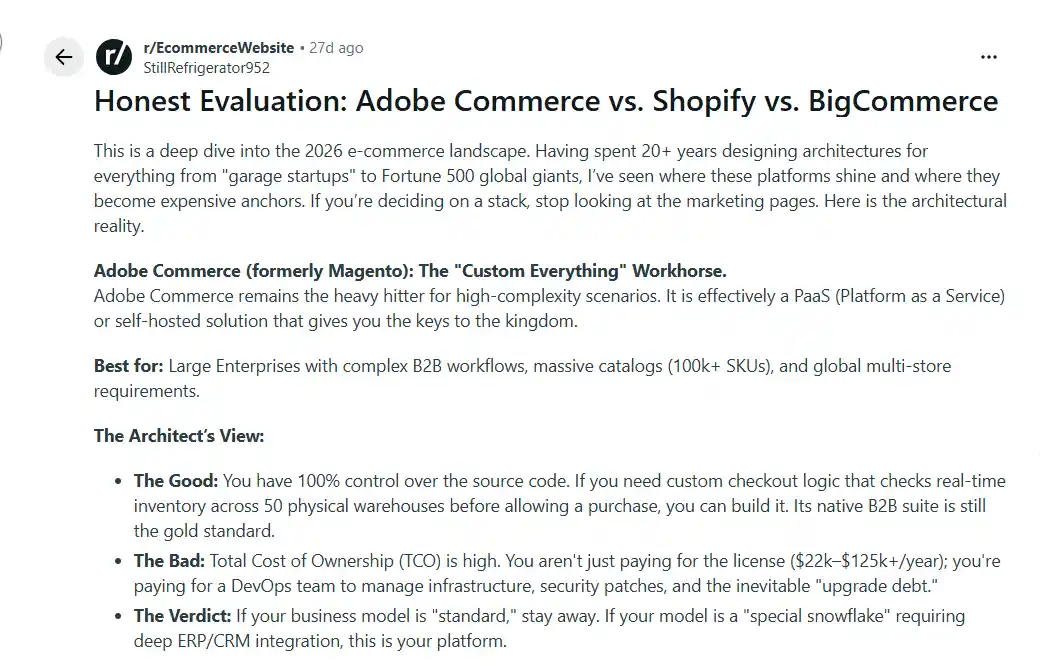
Reddit discussions about Magento/Adobe B2B almost always revolve around customization, ERP integrations, implementation costs (not in a positive light), and agency dependence. You can clearly see admiration and visible exhaustion, sometimes in the same sentence. And the overall impression is that, if your workflow is complex and demanding, then yes, Adobe Commerce is your B2B eCommerce solution, but if you have only simple operations, then you better opt for something else.
What G2 users say
Adobe Commerce has a score of 4.5/5 based on the G2 reviews. They describe it as a highly flexible and customizable option that lets you handle both B2C and B2B operations, but note that you need some technical knowledge to set it up or customize it, which is pretty much time-consuming.
Pros
- Extremely customizable
- Enterprise-grade scalability
- Huge ecosystem
- Strong B2B capabilities
Cons
- Expensive
- Long implementation timelines
- Development-heavy
- Higher maintenance overhead
Price:
Adobe Commerce pricing is not publicly available, but according to Reddit posts, only implementation cost can range from $22,000 to $125,000
My verdict
Adobe Commerce is still one of the strongest enterprise B2B platforms available. You just need to be emotionally prepared for what enterprise customization actually means and to have an extensive budget for it.
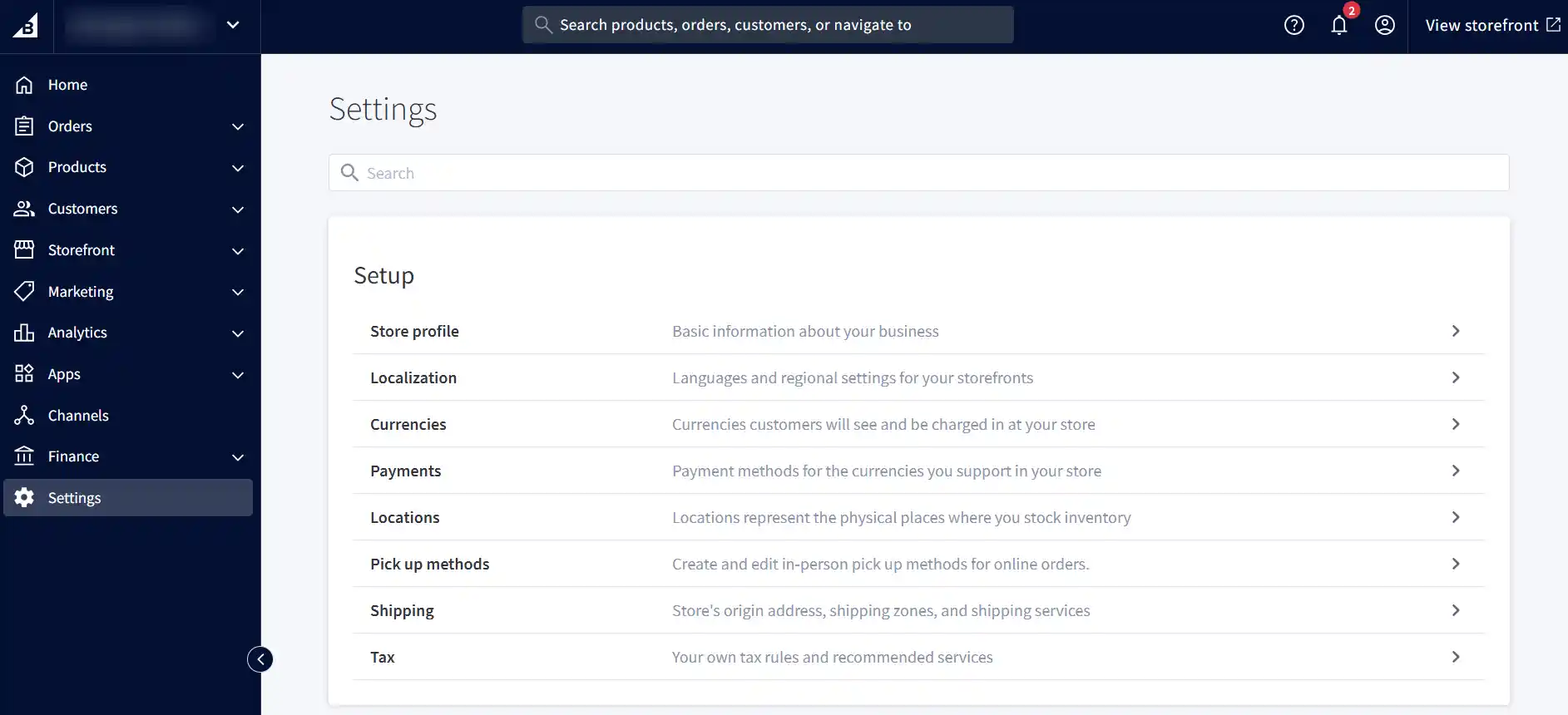
6. BigCommerce B2B Edition: Best for Mid-Market Companies Scaling Wholesale Operations
BigCommerce positions itself as a flexible SaaS platform capable of supporting both B2C and B2B commerce without forcing businesses into enterprise-level complexity too early. Its B2B Edition focuses on company accounts, custom pricing, quoting workflows, and buyer self-service, making it particularly attractive for growing wholesalers and hybrid commerce brands.
Best for:
Mid-market companies balancing between B2B and B2C.
What stood out:
BigCommerce sits in an interesting middle ground. It’s more operationally flexible than many retail-first platforms, but generally less overwhelming than Adobe or OroCommerce.
That balance makes it attractive for growing wholesalers and hybrid commerce businesses.
What Reddit users say
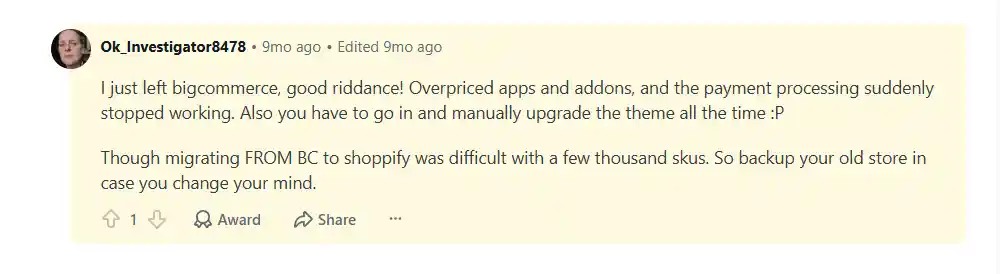
Redditors are pretty harsh on BigCommerce, mostly due to its add-on practice, but they give it credit for built-in features and flexibility out of the box.
What G2 users say
On G2, users rated BigCommerce 4.2/5, and they do appreciate the B2B functions this e-commerce platform is offering, but they emphasize it’s still primarily a B2C platform.
Pros
- Easier implementation
- Good API flexibility
- Strong SaaS structure
- Good hybrid commerce support
Cons
- Advanced B2B often requires extensions
- Less enterprise depth than Oro or Adobe
Price:
There is no publicly available pricing, but you have a free trial.
My verdict
BigCommerce is often strongest when businesses want flexibility without entering full enterprise-complexity territory. But you have to bear in mind that it does look more like a B2C platform, so you might experience challenges when it comes to B2B buyers.
7. Virto Commerce: Best for API-Driven B2B Architectures
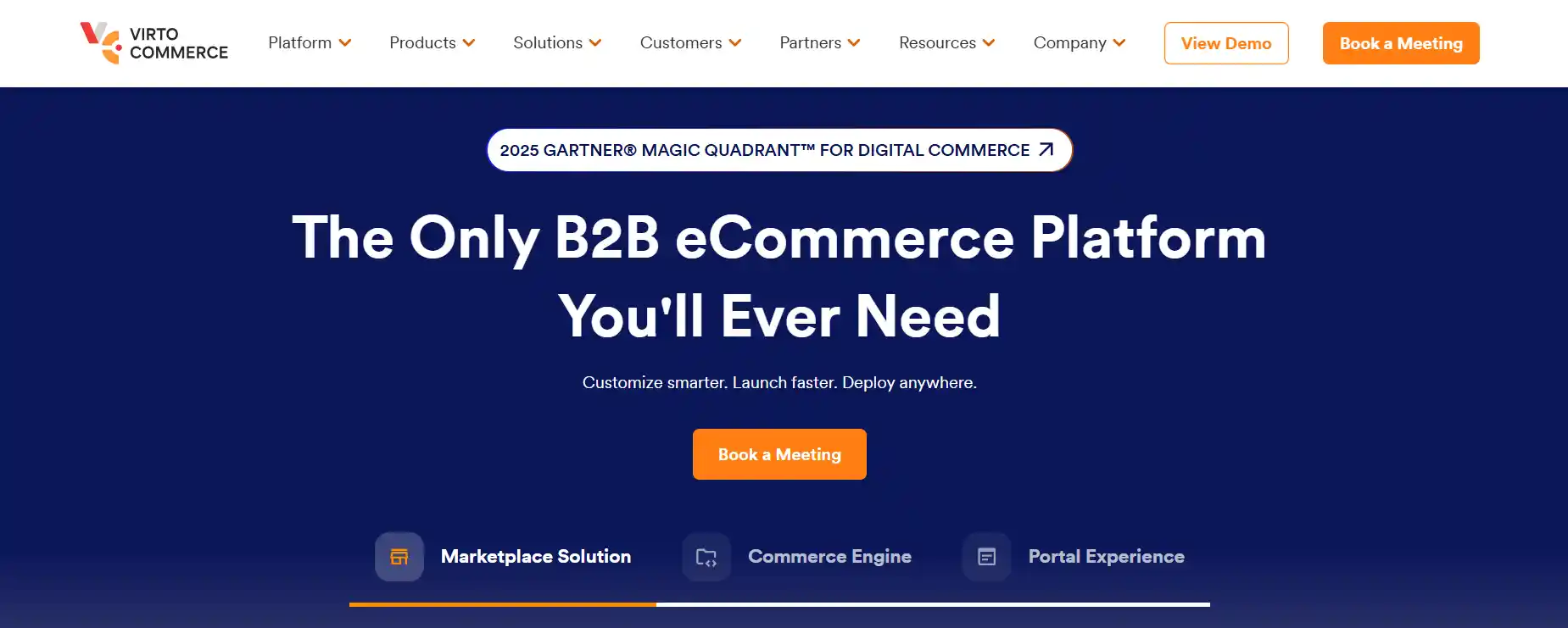
Virto Commerce is designed for enterprises building highly customized and composable commerce ecosystems. Rather than offering a rigid out-of-the-box storefront approach, Virto focuses on API-first flexibility, modular architecture, and deep customization possibilities for organizations managing complex digital transformation projects across multiple systems and channels.
Best for:
Composable enterprise commerce environments.
What stood out:
Virto Commerce is very much a “future architecture” platform. This is for organizations thinking:
- modular commerce
- composable systems
- API-first infrastructure
- enterprise orchestration
It’s not for those. “We need a simple wholesale store next month.”
What Reddit users say:
Redditors are pretty quiet regarding VirtoCommerce. There are no Reddit posts about this platform.
What G2 users say:
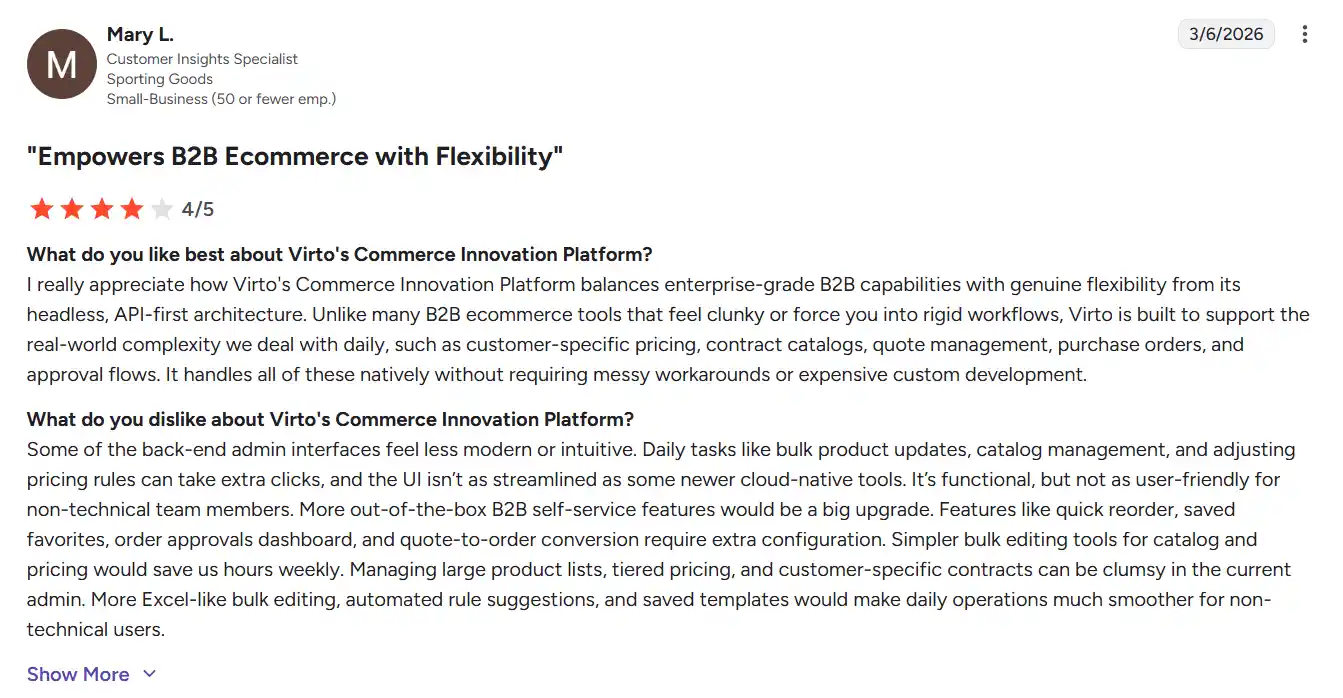
Virto Commerce has a 4.6/5 rating on G2, and users are very satisfied with its API-first architecture and the flexibility it provides. But, on the flip side, they note there should be more B2B self-service features.
Pros
- Extremely flexible API-first and composable architecture
- Strong for enterprises building custom commerce ecosystems
- Excellent scalability for complex B2B operations
- Deep integration possibilities across ERP, CRM, PIM, and third-party systems
- Well-suited for multi-store, multi-region, and multi-brand environments
Cons
- Requires strong technical resources or implementation partners
- Not ideal for companies looking for fast out-of-the-box deployment
- Higher implementation complexity compared to SaaS-first platforms
- Can feel overwhelming for mid-market businesses with simpler B2B needs
- Less beginner-friendly than platforms like Shopify or BigCommerce
Price:
Virto Commerce offers two models: GMV-based Pricing Model with a subscription that starts at 0.5% of GMV with 10K SKUs, and Order-based Pricing Model that starts at 2$ per order with 10K SKUs
My verdict
Virto Commerce feels less like a traditional e-commerce platform and more like a commerce infrastructure framework for enterprises that want complete architectural control. For the right organization, that flexibility is incredibly powerful. For smaller teams without strong technical capabilities, it can quickly become more platform than they realistically need. Potentially excessive for companies wanting operational simplicity.
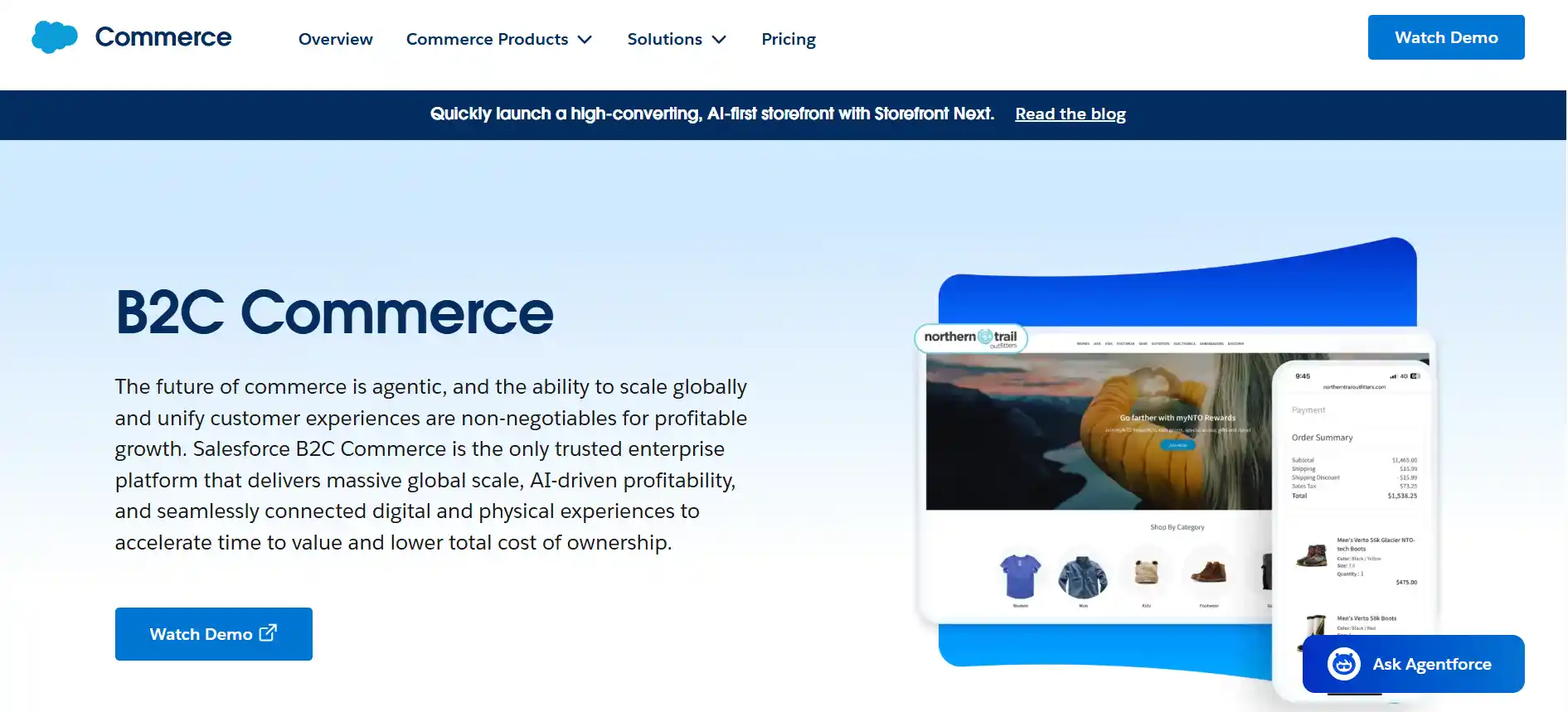
8. Salesforce B2B Commerce: Best for Companies Already Deep Inside the Salesforce Ecosystem
Salesforce B2B Commerce is built primarily for organizations already operating heavily inside Salesforce’s CRM and operational ecosystem. Its biggest advantage is centralized customer, sales, and commerce data, allowing businesses to align sales teams, procurement workflows, customer service, and ecommerce operations under a single enterprise environment.
Best for:
Organizations already deeply invested in Salesforce.
What stood out:
If your company lives inside Salesforce already, this platform becomes much more attractive. If not, the value proposition becomes less obvious.
The biggest advantage here is ecosystem alignment. The biggest disadvantage is… ecosystem alignment.
Because once you go deep into Salesforce infrastructure, switching directions later becomes complicated and expensive very quickly.
What Reddit users say:
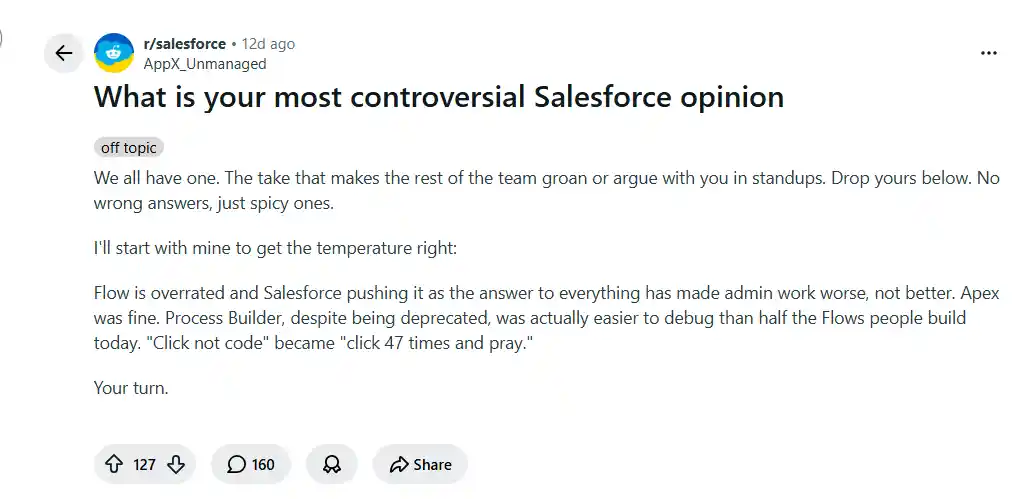
There was an interesting recent discussion on Reddit about Salesforce. And they all agree that Salesforce is incredibly powerful. But power, complexity, customization, certifications, consultants, automation, and AI hype have created an ecosystem that sometimes forgets the original goal: helping businesses operate more efficiently. We could read that there’s no single platform that’s a good solution for every business, and that smaller businesses should probably opt for a less complex alternative.
What G2 users say:
Salesforce B2B Commerce has a score of 4.4/5 on G2, and users praise the platform’s out-of-the-box ability to connect Identity (SSO) with custom pricing, emphasizing it’s the perfect choice for engineering-led organizations that want to digitize and manage high-scale B2B relationships. On the flip side, complex B2B logic, the GMV-based pricing model, and the fact that over time you’ll need the devs to keep it functioning (on the highest level), will probably cost you more than you thought initially.
Pros
- Deep native CRM integration
- Strong personalization and customer data capabilities
- Excellent for large enterprise organizations
- Advanced workflow automation
- Strong AI and analytics direction with Agentforce
- Good support for account-based B2B purchasing
- Strong multi-team operational visibility
Cons
- Expensive at scale
- Complex implementation process
- Heavy dependency on Salesforce ecosystem
- Can become overwhelming for mid-market companies
- Significant customization often requires external partners
Price:
Salesforce doesn’t display prices publicly.
My verdict
Salesforce B2B Commerce makes the most sense when commerce is only one part of a much larger customer operations strategy. If your organization already runs deeply on Salesforce, the platform can create a genuinely unified ecosystem across sales, service, procurement, and ecommerce. But if you’re starting from scratch, you need to be very honest about whether you want a commerce platform… or an entire enterprise universe that occasionally asks for another consulting budget approval.
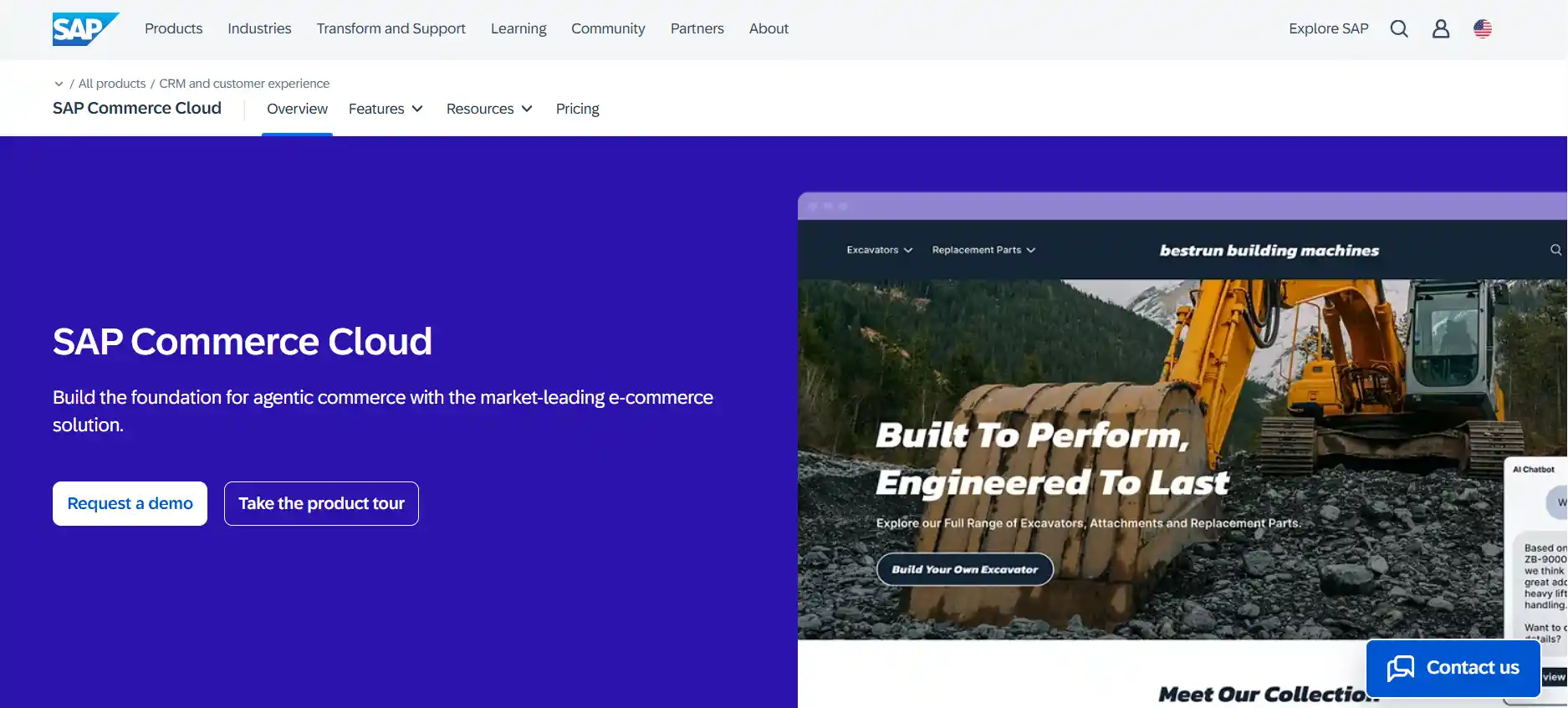
9. SAP Commerce Cloud: Best for Global Enterprises Managing Massive Operational Complexity
SAP Commerce Cloud is one of the most enterprise-oriented platforms in the B2B commerce market, targeting multinational manufacturers, distributors, and large procurement-heavy organizations. The platform focuses heavily on scalability, international commerce operations, ERP synchronization, and advanced organizational structures that large corporations typically require.
Best for:
Large global enterprises.
What stood out:
SAP Commerce Cloud is serious enterprise software for serious enterprise operations. And it behaves exactly like serious enterprise software. It means it’s powerful, scalable, operationally deep, and occasionally terrifying.
What Reddit users say
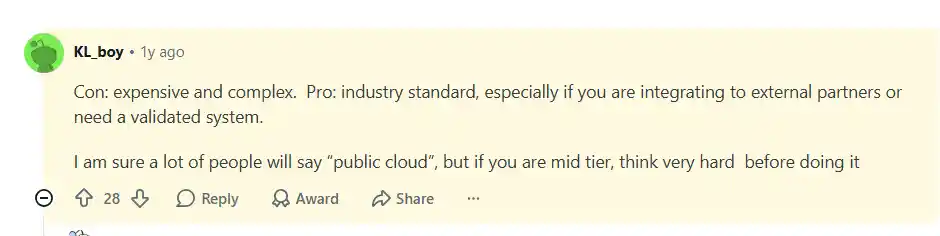
Well… Reddit users agree it’s an industry standard… but at the same time, it’s complex and expensive, so if you’re below 1B, you might rethink your options.
What G2 users say
SAP Commerce Cloud has a 4.3/5 rating on G2, and users appreciate its ability to handle complex workflows, multiple storefronts, and large catalogs. On the other hand, simple catalog changes or configuration tweaks can take more steps than expected and aren’t always intuitive.
Pros
- Excellent integration with SAP ERP and SAP S/4HANA ecosystems
- Extremely scalable for global enterprise operations
- Strong support for complex B2B workflows and procurement structures
- Handles large catalogs, multi-brand, and multi-region environments well
- Advanced customization and extensibility capabilities
- Strong omnichannel commerce functionality
- Good fit for enterprises managing B2B, B2C, and hybrid commerce simultaneously
- Centralized operational visibility across inventory, pricing, orders, and customer data
Cons
- Very steep learning curve for admins and developers
- Expensive implementation and maintenance costs
- Often requires experienced SAP consultants or implementation partners
- Customizations can become highly technical and time-consuming
- Long deployment timelines compared to SaaS-first competitors
- Some users find the backoffice UX outdated or unintuitive
- Can feel overly complex for mid-market businesses
- Vendor dependency inside the SAP ecosystem is a recurring complaint
Price:
The SAP Commerce Cloud price is not public; they have three plans.
My verdict
SAP Commerce Cloud feels less like a traditional e-commerce platform and more like an enterprise operational infrastructure with a storefront attached to it. For global manufacturers, distributors, and corporations already deeply invested in SAP, that level of integration and scalability can be incredibly powerful. But for smaller or mid-market companies, the platform can quickly become overwhelming both technically and financially.
10. commercetools: Best for Enterprises Building Composable B2B Commerce Architectures
Commercetools is one of the biggest names in composable and headless commerce, especially among enterprise manufacturers, distributors, and global B2B organizations looking to escape rigid monolithic systems. Founded in Germany and known as one of the original pioneers of MACH architecture (Microservices, API-first, Cloud-native, Headless), commercetools focuses heavily on flexibility, scalability, and modular commerce infrastructure rather than traditional out-of-the-box storefronts.
Best for:
Large manufacturers, distributors, and enterprise B2B companies that want API-first flexibility, composable commerce, and highly scalable multi-region operations.
What stood out:
Commercetools feels less like a traditional e-commerce platform and more like enterprise commerce infrastructure. Its biggest advantage is architectural freedom: companies can build highly customized B2B experiences without being locked into rigid frontend or backend structures.
What Reddit users say:
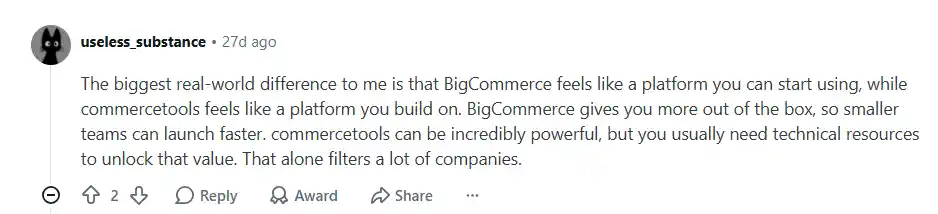
A recurring theme is that companies love the flexibility and scalability, but many also underestimate how much internal development and architectural ownership composable commerce actually requires.
What G2 users say:
Commercetools has a score of 4.5/5 on G2, and users value its highly flexible structure and outstanding expandability, but they emphasize it’s not that easy to set it up (you’ll need tech knowledge), and built-in data visualization falls short for our daily analysis work
Pros
- Extremely flexible composable architecture
- Strong API-first infrastructure
- Excellent scalability for enterprise B2B
- Advanced B2B workflows and account structures
- Good fit for multi-brand and multi-region commerce
- Strong AI and agentic commerce positioning
- Transparent order-based pricing model instead of GMV fees
Cons
- Requires strong technical resources
- Higher implementation complexity
- Less suitable for mid-market companies wanting simplicity
- Composable architecture can increase operational overhead
- Often requires implementation partners or experienced dev teams
- Longer time-to-value compared to SaaS-first platforms
Price:
Commercetools does not display prices publicly.
My verdict
Commercetools feels less like a traditional e-commerce platform and more like an enterprise commerce infrastructure for organizations that want maximum architectural freedom. For technically mature manufacturers and distributors with large-scale operations, that flexibility can be incredibly powerful. But for companies seeking operational simplicity or lean internal teams, composable commerce can sometimes introduce a different kind of complexity rather than eliminate it.
What Reddit Users Actually Hate About B2B Platforms in 2026
After going through discussion after discussion, a few themes appeared constantly. And honestly, the complaints are remarkably consistent across platforms.
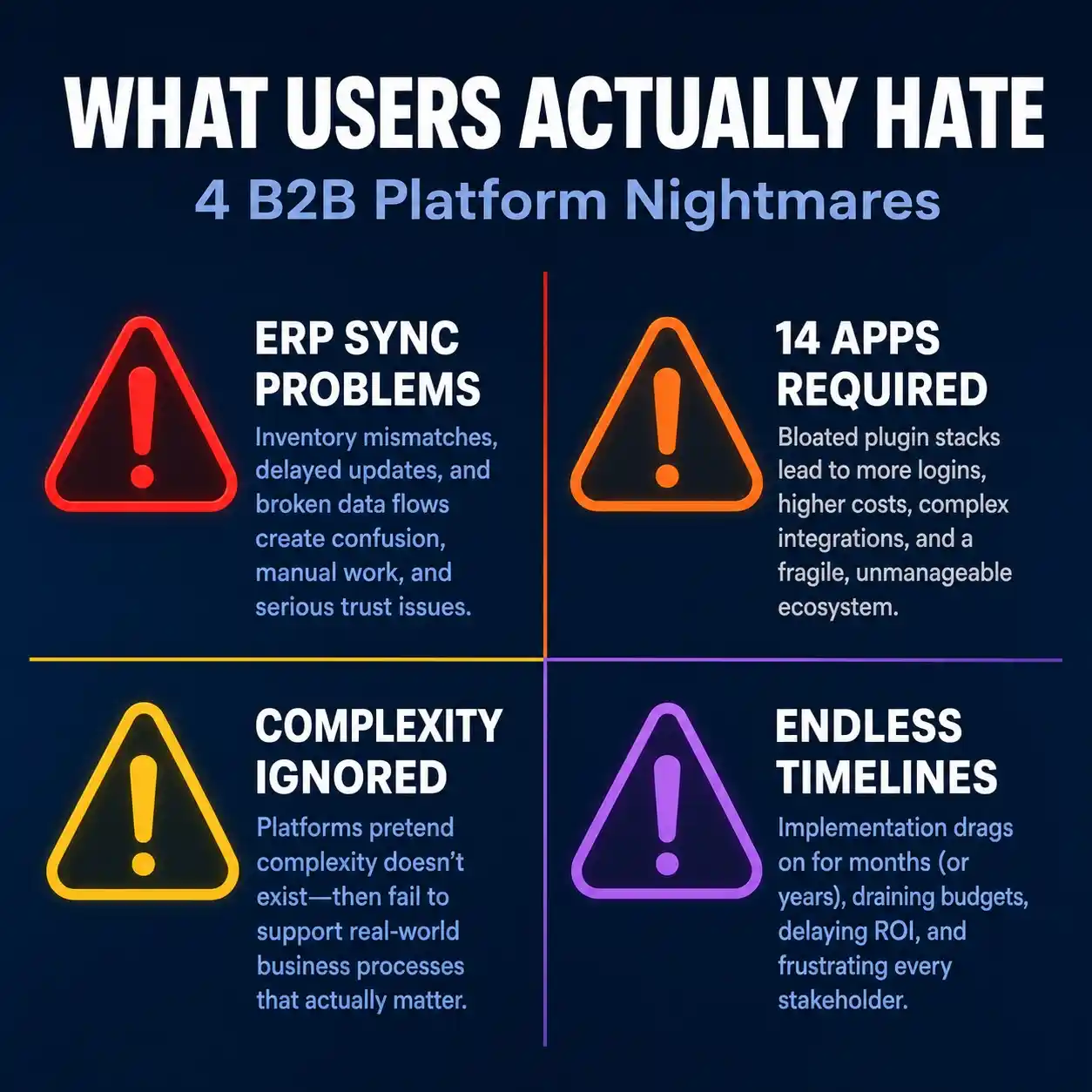
1. ERP synchronization problems
This is the king of B2B nightmares. When pricing, inventory, or orders drift away from ERP reality, trust disappears immediately.
One Reddit user recently described a situation where Shopify showed inventory as available, the customer placed the order, and only afterward did the warehouse reality catch up: the stock simply wasn’t there. The entire discussion quickly turned into a broader conversation about ERP synchronization, delayed inventory updates, disconnected systems, and operational trust breaking down between commerce, warehouse, and finance teams.
2. “B2B features” that require 14 apps
This comes up constantly with retail-first platforms. Users get frustrated when critical workflows depend on stacking plugins on top of plugins until the entire system starts resembling digital Jenga.
One Reddit user, for example, expresses frustration with the WooCommerce B2B business option, describing it as “a mess of different plugins and patchy workflows.”
3. Platforms pretending complexity doesn’t exist
A surprising number of tools still market B2B as: “bulk discounts + login page.”
Meanwhile, real manufacturers are managing:
- approvals
- procurement teams
- distributor permissions
- RFQs
- negotiated contracts
- warehouse allocation
- regional pricing
- EDI
- sales reps
Entirely different universe… and according to Reddit users, that’s one of the main causes why finding the right B2B solution is so challenging.
4. Implementation timelines
Enterprise implementations can become painfully long. Sometimes deservedly. Sometimes unnecessarily. But almost every Reddit thread eventually contains someone saying:
“This took way longer than expected.”
Which might honestly be the official slogan of enterprise software.
The Big Shift Happening in B2B Right Now
The biggest shift in B2B commerce is not prettier storefronts. It’s operational digitization.
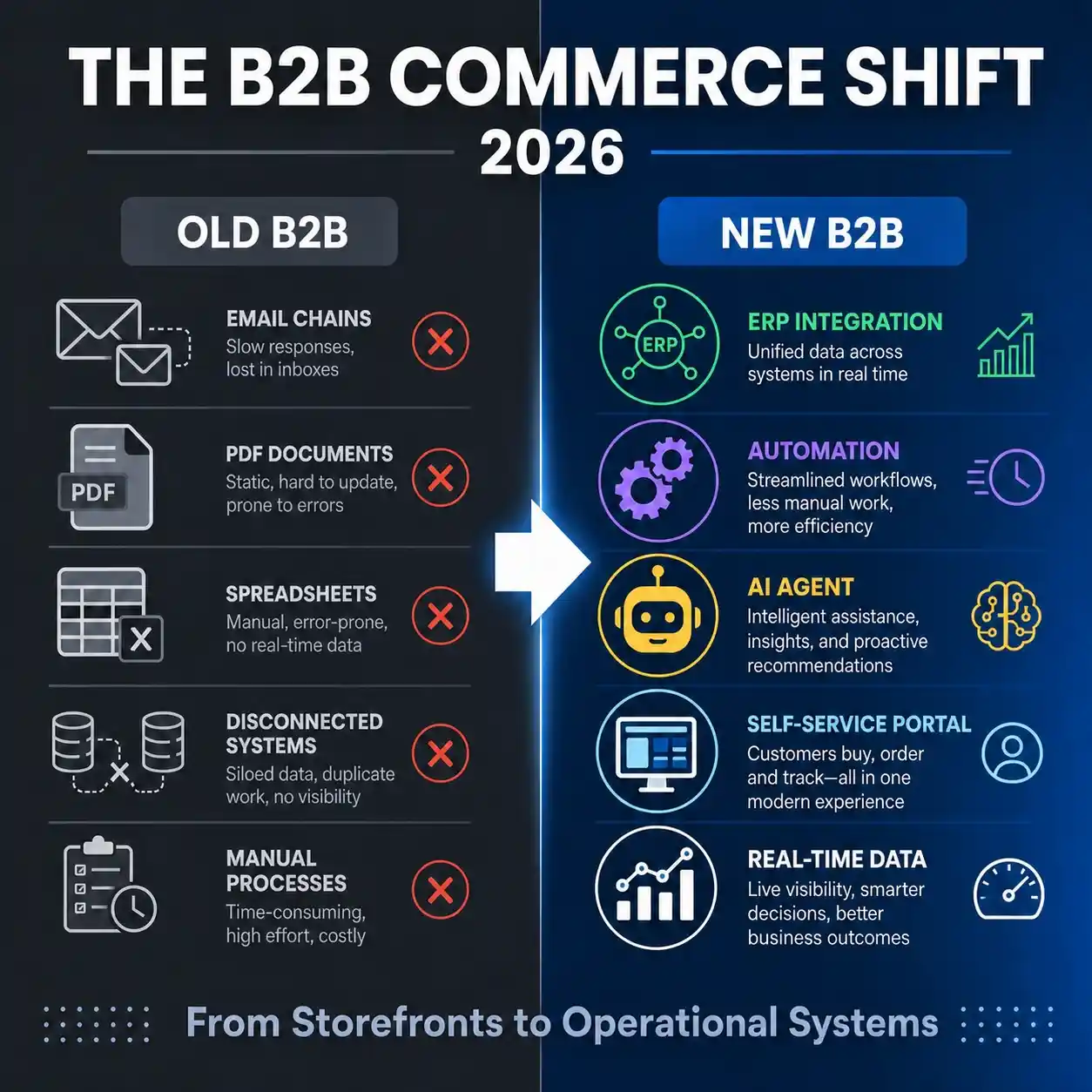
The winners in 2026 are increasingly the platforms that:
- connect deeply with ERP systems
- reduce manual operational work
- support self-service procurement
- centralize data
- enable automation
- prepare for AI-assisted workflows
That last point matters more than people realize.
Because AI agents are beginning to move beyond content generation and into operational assistance:
- procurement
- reordering
- quoting
- inventory visibility
- portal navigation
And platforms that expose structured operational data cleanly will have a massive advantage.
This is why MCP-style connectivity and AI-ready architectures are becoming increasingly important.
The future B2B portal is not just a storefront.
It’s an operational interface.
Which Platform Is Best by Use Case?
There’s no such thing as one platform built for every use case. Each industry, segment, or company size has features that are “a must”. And based on that, here are some suggestions that might help you navigate the B2B eCommerce platforms world.
Best for manufacturers
If we’re talking specifically about manufacturers, the strongest platforms are usually B2Bware, Sana Commerce, and OroCommerce.
And honestly, the reason has very little to do with storefront design.
Manufacturers typically care far more about:
- ERP synchronization
- inventory visibility
- distributor management
- quoting workflows
- customer-specific pricing
- regional catalogs
- operational automation
- procurement logic
than about having the trendiest ecommerce frontend.
That’s why B2Bware stands out for companies trying to modernize operations without replacing existing ERP and PIM infrastructure. Sana Commerce is especially strong when the ERP already acts as the operational “brain” of the company, while OroCommerce excels in more enterprise-heavy environments with layered procurement workflows, account hierarchies, approvals, and RFQs.
The common denominator between all three is operational depth.
They’re built around the reality that manufacturing commerce is usually an extension of operational systems, not just a digital storefront.
Best for distributors
For distributors, the strongest options are usually OroCommerce, B2Bware, and SAP Commerce Cloud.
And the reason is simple:
distribution businesses tend to operate in controlled chaos.
They’re managing:
- multiple warehouses
- distributor networks
- customer-specific agreements
- account hierarchies
- procurement teams
- regional inventory
- large catalogs
- negotiated pricing
- complex reorder flows
This is where many “simple wholesale” platforms start collapsing under operational pressure.
OroCommerce is especially strong for enterprise distribution environments because of its permissions, approvals, organizational structures, and procurement tooling. B2Bware works particularly well for ERP-heavy distributors trying to centralize operational workflows without creating massive integration dependency, while SAP Commerce Cloud is often chosen by large global distribution organizations already deeply invested in SAP infrastructure.
For distributors, the biggest differentiator usually isn’t frontend UX.
It’s whether the platform can survive operational complexity without turning every workflow into manual damage control.
Best Shopify alternative
If you’ve outgrown Shopify B2B or are worried about app dependency, the strongest alternatives are usually B2Bware, commercetools, and OroCommerce.
The pattern behind most Shopify migrations is surprisingly consistent:
companies love the simplicity at first, but eventually hit operational walls around:
- ERP synchronization
- approvals
- customer-specific workflows
- distributor permissions
- quoting
- multi-region complexity
- large catalogs
- app stacking
That’s where these alternatives become interesting.
B2Bware focuses heavily on operational simplicity and ERP connectivity for manufacturers and distributors. commercetools is ideal for enterprises pursuing composable commerce and API-first flexibility, while OroCommerce is often the strongest fit for organizations that need deeply layered B2B procurement workflows without relying on dozens of third-party apps.
The real question companies eventually ask themselves is:
“Do we still want a retail-first platform with B2B extensions… or a platform designed around B2B operations from the start?”
And in many cases, that’s the moment the migration conversation begins.
Best for ERP-heavy businesses
If your ERP already runs most of the business logic, the strongest platforms are usually Sana Commerce, SAP Commerce Cloud, Adobe Commerce, and B2Bware.
These platforms work best when ecommerce is treated as part of a broader operational ecosystem rather than a separate storefront layer.
For ERP-heavy businesses, the priorities are completely different from traditional ecommerce:
- real-time inventory synchronization
- customer-specific pricing
- warehouse visibility
- order synchronization
- procurement logic
- centralized operational data
- reducing manual workflows
Sana Commerce is particularly strong because it treats the ERP as the operational source of truth. SAP Commerce Cloud makes the most sense for large global enterprises already deeply embedded inside SAP infrastructure, while Adobe Commerce offers enormous customization flexibility for organizations willing to manage the complexity that comes with it.
B2Bware fits especially well for companies trying to modernize B2B operations without replacing the ERP systems they already depend on daily.
And honestly, this is becoming one of the biggest themes in B2B commerce right now:
the winners are increasingly the platforms that reduce operational friction, not the ones with the prettiest storefronts.
Best for fast implementation
If implementation speed matters most, Shopify B2B and BigCommerce are usually the strongest options.
This is especially true for:
- smaller wholesale teams
- hybrid B2C/B2B brands
- companies testing wholesale operations
- businesses without large internal IT departments
- organizations trying to launch quickly
Their biggest advantage is operational simplicity.
Compared to enterprise-heavy ecosystems, these platforms generally:
- require fewer implementation partners
- have easier onboarding
- offer faster deployment
- reduce technical overhead
- provide more approachable administration
Of course, the tradeoff is that highly complex B2B workflows often require additional apps, integrations, or customizations later.
Best for enterprise complexity
For enterprise-level B2B complexity, Adobe Commerce, OroCommerce, SAP Commerce Cloud, and commercetools are usually the strongest choices.
These platforms are designed for organizations dealing with:
- global operations
- multi-brand environments
- regional pricing
- massive catalogs
- procurement hierarchies
- distributor ecosystems
- complex approvals
- advanced integrations
- enterprise security and compliance requirements
OroCommerce stands out for pure B2B procurement logic and organizational complexity. Adobe Commerce remains one of the most customizable enterprise ecosystems available, while SAP Commerce Cloud dominates among corporations already operating deeply inside SAP infrastructure.
commercetools takes a different approach entirely by focusing on composable architecture and API-first flexibility, making it particularly attractive for enterprises building highly customized digital ecosystems.
The common thread here is scalability.
Not just traffic scalability, but operational scalability:
the ability to manage growing complexity without rebuilding the entire commerce infrastructure every few years.
Best for modern composable commerce
If composable commerce is the priority, commercetools and Virto Commerce are probably the strongest fits.
These platforms focus heavily on:
- API-first architecture
- modular commerce
- headless flexibility
- microservices
- custom frontend freedom
- enterprise integrations
- long-term scalability
This makes them especially attractive for enterprises with strong internal development teams and complex digital transformation roadmaps.
But composable commerce also comes with a tradeoff many vendors quietly downplay:
freedom creates responsibility.
The more flexible the architecture becomes, the more ownership companies take over:
- integrations
- orchestration
- maintenance
- frontend management
- operational complexity
That’s why composable commerce tends to work best for technically mature organizations that already know exactly how they want their commerce ecosystem to function long-term.
For everyone else, “maximum flexibility” can sometimes become another name for “we accidentally built our own software company.”
Final Thoughts
The biggest thing I realized while researching these platforms is that most B2B ecommerce problems are not actually ecommerce problems.
They’re operational problems disguised as ecommerce problems.
The real friction usually starts when inventory no longer matches ERP reality, pricing becomes inconsistent across systems, approvals happen manually through email chains, and sales teams spend half their day fixing preventable mistakes instead of selling. And honestly, that pattern appears constantly across Reddit discussions around B2B commerce, ERP systems, and wholesale operations.
That’s why the strongest B2B platforms in 2026 are no longer just storefronts. They’re operational infrastructure.
The companies moving fastest right now are usually the ones building centralized, ERP-connected systems that reduce operational friction instead of adding another layer of complexity. And with AI increasingly moving into procurement, quoting, reordering, workflow automation, and inventory visibility, that operational foundation is about to matter even more.
Because in B2B, nobody cares how beautiful the portal looks if procurement still has to send three emails and a PDF just to place an order.
That’s not digital transformation.
That’s just prettier chaos.
If your business is trying to simplify complex B2B operations instead of stacking more apps and workarounds on top of them, it may be worth exploring how B2Bware approaches ERP-connected B2B commerce differently.